Coal Changes Jobs
Coal isn't just for power plants anymore. China is building the infrastructure to turn it into fuel, plastics, and fertilizer — and treating it as a national security asset.

There is a technology that turns coal into diesel fuel. It is about a century old. It was invented in Germany, industrialized by apartheid South Africa under oil sanctions, and for most of the last fifty years it has been an expensive curiosity. China is now building it at a scale nobody else has attempted.
Start with the number that frames the rest. In 2024 China produced 4,780 million tonnes of coal, more than half the world total and more than the next several producers combined. India, the second-largest producer, managed 1,085 million tonnes. The United States produced 465 million.[1]
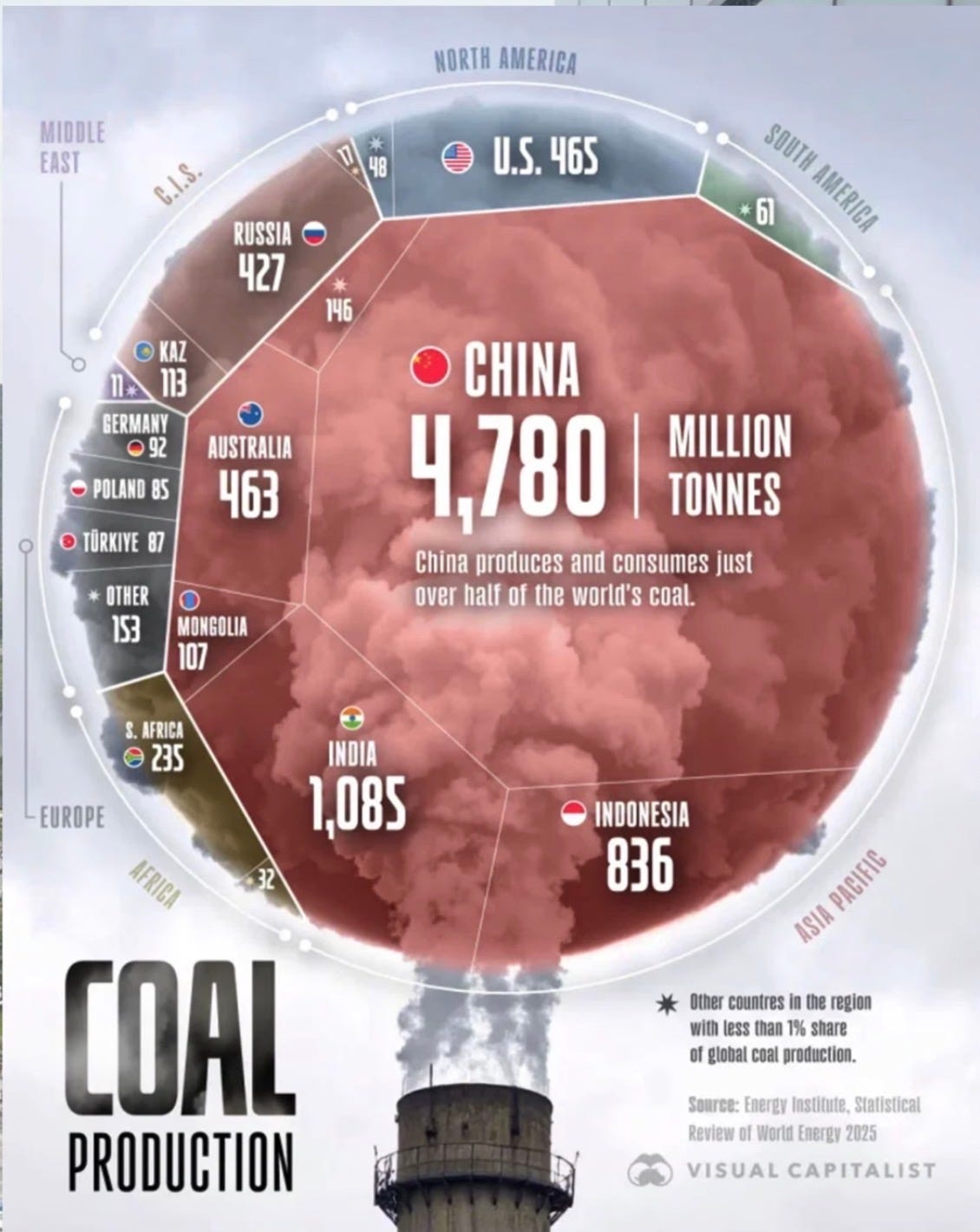
China produces and burns more coal than the rest of the world combined.
The baseline, in primary energy
Coal production is one measure. The more revealing one is primary energy, because it counts every joule the economy actually consumes rather than only the electricity it generates.
On that basis China consumed 162.2 exajoules in 2025, an increase of 296% since 2000. Coal alone accounts for roughly 92 EJ of that total, or about 57% of everything the country burns. Fossil fuels together supply 87.5%. Energy-related emissions reached 11.2 gigatonnes of CO₂, 31.3% of the global total.[2]
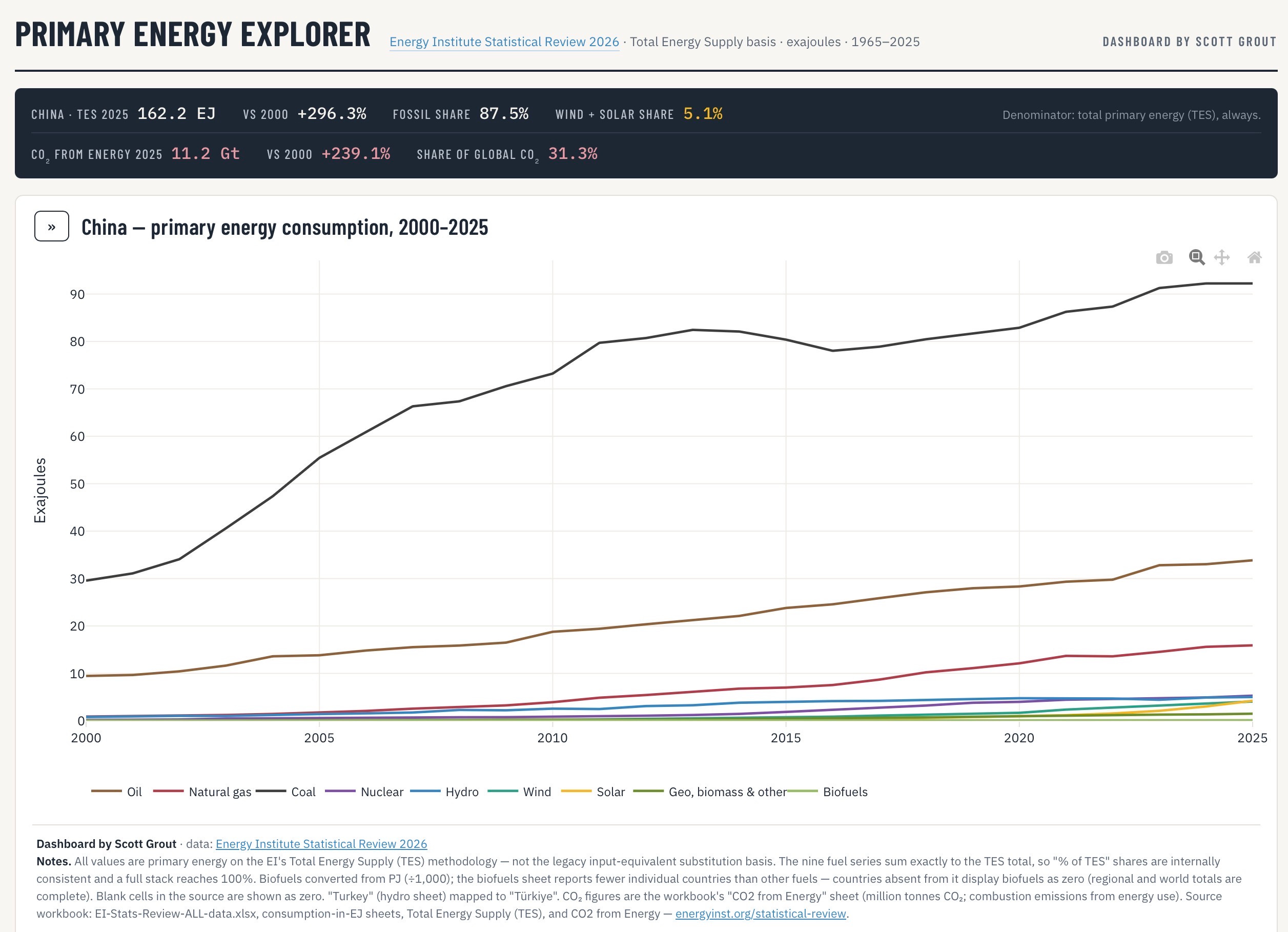
The coal line is the story. It has roughly tripled since 2000 and it has not turned over.
The coal line has not turned over. It flattened briefly around 2014 and then resumed climbing. What has changed is not the quantity of coal China consumes but the range of things it is asked to do.
Two ways to turn a rock into a liquid
Coal and oil are built from the same two elements. The difference is the ratio and the architecture. Coal is carbon-rich, hydrogen-poor, and locked into a rigid solid lattice. Oil is hydrogen-rich and flows. Converting one into the other means adding hydrogen and rearranging the molecular structure, and there are two ways to go about it.[3]
The indirect route demolishes the building and rebuilds it brick by brick. Coal is burned with restricted oxygen until it disintegrates into the simplest molecules available: carbon monoxide and hydrogen, a mixture called synthesis gas. Those are then passed over a catalyst that stitches them back into long hydrocarbon chains. This is the Fischer-Tropsch process, and because you are assembling the fuel from scratch, you control what comes out. The diesel is unusually clean, with essentially no sulfur and very few of the ring-shaped molecules called aromatics that produce soot. It also ignites more readily than petroleum diesel, which engines prefer.
The direct route renovates in place. Grind the coal to powder, suspend it in oil, and force hydrogen into the slurry under extreme heat and pressure until it liquefies. Less energy is wasted, but the product is a tarry mixture requiring heavy downstream processing, and the reactors must survive conditions that destroy ordinary steel. It is genuinely difficult engineering, and China Energy runs the only commercial direct-liquefaction plant in the world, in Inner Mongolia, at about a million tonnes a year.[4]
Everything at real scale uses the indirect route.
The largest plant ever built, and what it actually delivers
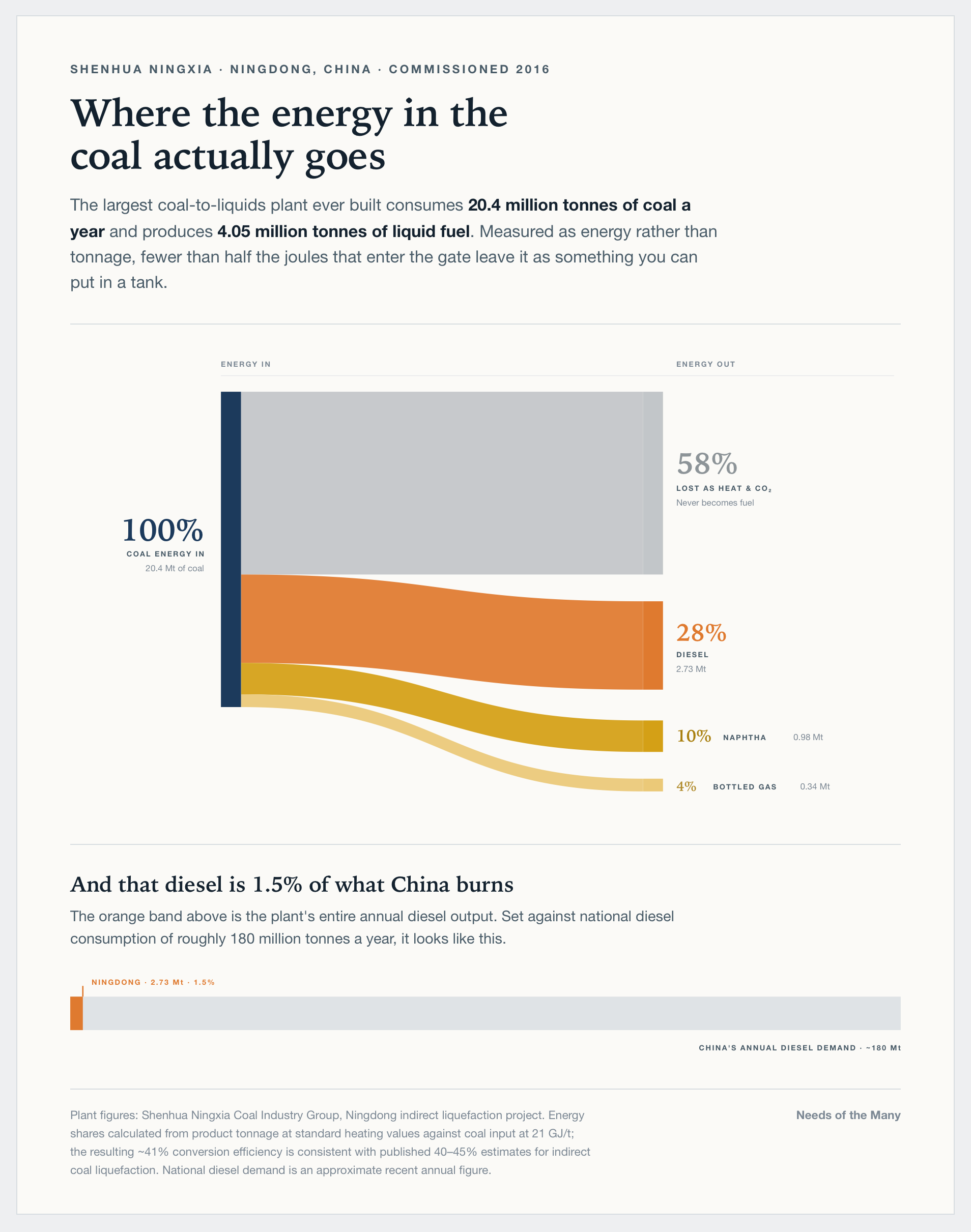
Shenhua Ningxia's facility at Ningdong cost 55 billion yuan, roughly $8 billion. It consumes about 20.4 million tonnes of coal a year and produces 4.05 million tonnes of liquids: 2.73 million tonnes of diesel, 983,000 tonnes of naphtha (the light, gasoline-like liquid that plastics are made from), and 336,000 tonnes of the propane and butane sold as bottled cooking gas.[5]
China burns roughly 180 million tonnes of diesel a year. So the largest coal-to-liquids plant ever constructed, an $8 billion machine consuming a small mountain of coal every day, covers about 1.5% of national diesel demand. Its naphtha output is a similar sliver of what the plastics industry uses. The coal it swallows is about 0.4% of Chinese coal consumption. Across the whole sector, everything China made from coal in 2024 — liquids, gas, and chemicals together — displaced only about 6% of the oil and gas it imported.[6]
The largest coal-to-liquids plant ever built supplies about one and a half percent of China's diesel. Whatever this is, it is not a supply solution.
The energy accounting is less flattering still. Only about 41% of the energy in the coal ends up in the products. The rest leaves as waste heat and carbon dioxide.[7]
So why build it
China holds about 13% of proven global coal reserves. Russia holds more. Australia holds more. The United States holds nearly twice as much. Yet China produces more coal than everyone else on earth put together. It is not coal-rich in any comparative sense. It is coal-self-sufficient, extracting a moderate endowment at an extraordinary rate.[8]
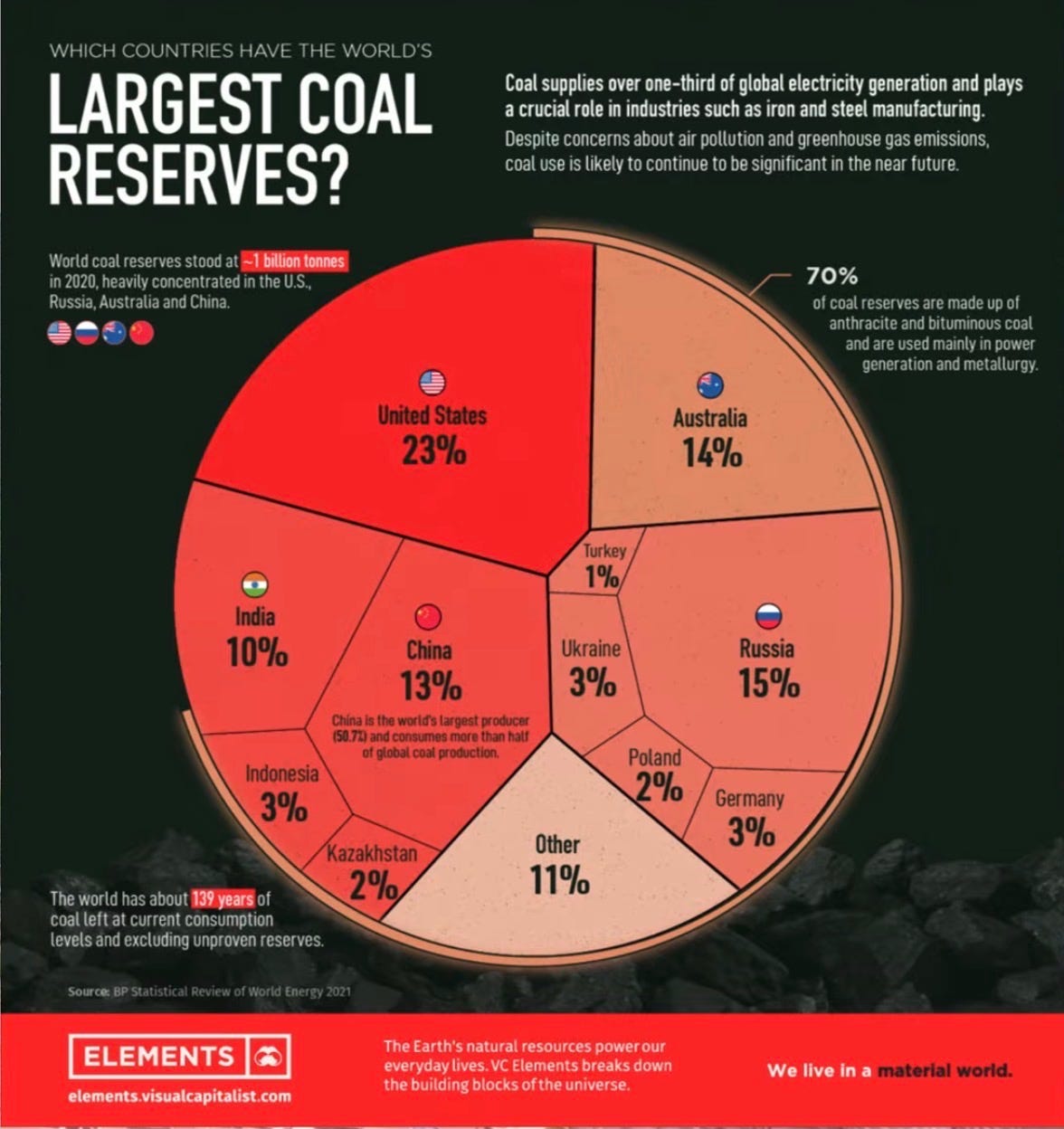
Thirteen percent of the reserves, more than half of the production. China's coal advantage is not geological abundance — it is that the coal is domestic.
Set that against oil, where China imports roughly three-quarters of what it consumes, against natural gas at about 60%, and against coal at roughly 10%.[9] The oil arrives by tanker through two narrow straits that a hostile navy could close in an afternoon. Fuel made in Ningxia cannot be blockaded, embargoed, or priced by OPEC.
Beijing has written it down
The NDRC’s 14th Five-Year Plan for a Modern Energy System files coal-based oil and gas bases under strategic reserves, not industrial policy.[10] The coal industry uses the same language — “national coal chemical strategic reserve capacity.”[11] The 15th Five-Year Plan, adopted in March 2026, then made energy self-sufficiency a headline target.[12]
Coal-to-liquids is not classified as an industry. It is classified as a reserve — capacity held against a contingency, not capacity built to earn a return.
The economics, once you stop calling it an investment
Judged as an investment, these plants look indefensible. Judged as insurance, they look prudent, and nobody evaluates fire insurance by its rate of return.
Lately however the arithmetic has improved on its own. Chinese analysts put the break-even for coal-to-diesel at roughly $55 to $65 a barrel.[14] With crude above $100 following this spring's Hormuz disruption, the advantage became conspicuous, and project approvals accelerated. China National Chemical Engineering has reported orders moving faster as a direct result.[15]
The underlying mechanism is a price gap on a per-tonne basis. Coal at the Qinhuangdao benchmark runs about $105 a tonne. Crude at $71 a barrel works out to roughly $525 a tonne.[16] You need about three tonnes of coal to make a tonne of finished liquid, but coal is five times cheaper per tonne, so the spread survives the conversion losses with room left over.
What it costs besides money
Carbon. Because you emit heavily to make the fuel and then again to burn it, a litre of coal-derived diesel carries roughly two to three times the lifecycle emissions of the petroleum version. Coal conversion is a principal reason China has fallen behind its own carbon intensity targets.
Water. The Ningdong complex consumes about 25 million tonnes of water a year. Ningxia is a desert province. Every one of these plants is sited on coal, and the coal in China is mostly in arid western regions where the water is not.
Capital. Roughly $100,000 for each barrel of daily output, about five times the cost of a conventional refinery. Enormous spending up front, cheap operation for decades afterward. Anyone who has looked at nuclear economics will recognize the shape immediately, and will recognize the consequence: only patient state capital builds assets structured that way. No private investor is going to underwrite a twenty-year payback against a commodity price they cannot forecast for eighteen months.
Coal changes jobs
Coal's traditional job is heat. Burn it, boil water, spin a turbine, and the joules become electricity. That job is well understood and it is the one every energy model tracks.
The new job is molecules. Diesel for the trucks that move a manufacturing economy. Naphtha for the plastics industry. Ammonia for the fertilizer that feeds 1.4 billion people. These are not energy in the sense of joules on a meter; they are physical inputs to industry and agriculture, and until now China has bought most of them from abroad in the form of crude oil and gas.
Coal's first job was heat. Its second is molecules — and molecules are precisely what China has to import.
The sector is small today, around one percent of Chinese liquid fuel supply, and it will stay small for years because the capital intensity limits how fast it can scale. But it is growing, it is state-backed, it is exempted from the coal consumption controls that apply to power generation, and Beijing approved a further $3.3 billion coal-to-olefins project at Ordos in May.[17]
The sector's importance is not its current size. It is that China has built a mechanism to convert a domestic solid into an imported liquid, has classified that mechanism as a strategic reserve, and has written into a national plan the intention to expand it.
References
[1] Energy Institute, Statistical Review of World Energy 2026, coal production by country. China 4,780 Mt; India 1,085 Mt; United States 465 Mt (2024 figures).
[2] Primary Energy Explorer, dashboard by Scott Grout, built on EI Statistical Review 2026 data (Total Energy Supply basis, exajoules, 1965–2025).
[3] Andrew J. Minchener, Coal-to-oil, gas and chemicals in China, IEA Clean Coal Centre, CCC/181 (2011), on direct and indirect liquefaction process chemistry and thermal efficiencies.
[4] China Energy Investment Corporation, on the Ordos direct coal liquefaction demonstration project (approx. 1 Mt/y), the only commercial DCL facility operating worldwide.
[5] Synfuels China and Shenhua Ningxia Coal Industry Group, project data for the Ningdong indirect liquefaction project: RMB 55 bn investment, 20.36 Mt/y coal input, 4.052 Mt/y liquid output (2.733 Mt diesel, 983 kt naphtha, 336 kt LPG).
[6] Reuters, "China's top coal region to expand coal-to-oil output in energy security push," 15 June 2026. China's 2024 coal-derived gas, liquids and chemicals output was sufficient to replace roughly 6% of that year's oil and gas imports.
[7] Author's calculation: product tonnage at standard heating values (diesel 43 GJ/t, naphtha 44.5 GJ/t, LPG 46 GJ/t) against coal input at 21 GJ/t, giving approximately 41% conversion efficiency. Consistent with the published 40–45% range for indirect coal liquefaction.
[8] BP Statistical Review of World Energy 2021, proven coal reserves by country, as visualized by Visual Capitalist Elements.
[9] Christoph Nedopil Wang, Green Finance & Development Center, FISF Fudan University, analysis of China's 15th Five-Year Plan, March 2026. Import dependency: approximately 72–75% for oil, 60% for natural gas, 10% for coal.
[10] NDRC and National Energy Administration, 14th Five-Year Plan for a Modern Energy System (2022). The provisions on coal-based oil and gas strategic bases appear under a section directing authorities to strengthen the technical reserve underpinning security strategy, alongside instructions to establish production capacity and technical reserves.
[11] China National Coal Association, Guidelines for Developing the Modern Coal Chemical Industry in the 14th Five-Year Plan, which call for establishing national coal chemical strategic reserve capacity. See also Guide to Chinese Climate Policy, Oxford Institute for Energy Studies, chapter 14, for a survey of the relevant central government documents.
[12] 15th Five-Year Plan (2026–2030), adopted March 2026, as analyzed in Nedopil Wang, op. cit. The plan directs China to persist in domestic self-sufficiency for core oil and gas demand, and elevates national energy self-sufficiency to a headline target, raising domestic energy production capacity from 5.13 to 5.8 billion tonnes of standard coal equivalent.
[13] Huang Zhiqiang, Vice Chairman of the Inner Mongolia Autonomous Region, press conference, 11 June 2026, as reported by Reuters.
[14] SunSirs commodity analysis, April 2026, placing the coal-to-oil break-even at approximately $55–65 per barrel and coal-to-olefins at $45–50 per barrel.
[15] China National Chemical Engineering Group Corp, investor platform disclosure, 2026, reporting accelerated approvals and order placement for modern coal chemical projects.
[16] Qinhuangdao benchmark thermal coal at approximately $105–110 per tonne against Brent-equivalent crude at roughly $525 per tonne at $71 per barrel.
[17] Ministry of Ecology and Environment approval, May 2026, for a RMB 22.1 bn (US$3.3 bn) 800,000 t/y coal-to-olefins demonstration project at Ordos, Inner Mongolia.
Thermal coal for electrical power is the most straightforward to substitute, as there are other ways to make electricity: nuclear, gas, hydro, geothermal, solar, wind. (Taking into account economics, grid reliability/security, already large installed base of “young” coal-fired power plants). You haven’t mentioned steelmaking, a process for which substitutes for the use of metallurgical coal have a long way to go before they’d replace met coal.
I was working on a Cape Town refinery expansion in the mid 1970s when South Africa started building the Fischer-Tropsch process. Most refineries were running Iranian crude as others were sanctioned over Apartheid issues. I thought that looked like a good idea as the country had domestic coal and short on foreign exchange and on crude oil supply options.
The Africaans government was sort of then on today’s Chinese economic principle?
Thanks for your observations on the economic of using domestic coal to liquids versus importing crude oil.
The principle kind of applies to India, Indonesia and other developing nations that have domestic coal. It was my belief then in those old days of my career that such nations are not really interested in solely “pure” perceived economics. Creating employment - even in coal mines - was an equal imperative.