Dark, Still, and Expensive
Five ways to survive a multi-day renewable drought — and why gas still wins by 25×

Every debate about wind and solar eventually collides with the same inconvenient stretch of weather. The Germans have a word for it — dunkelflaute, the dark doldrums — when a stationary high-pressure system parks over a continent and shuts down wind and sun together for days at a time. These are not hypothetical stress tests. Europe now averages 1.6 such events per year, and two of them in late 2024 pushed German power prices past €800 per megawatt-hour — more than ten times the recent average of roughly €40–80 — while fossil plants ran flat out. The first table below documents five real events. The second asks the question they force: if wind and solar are to supply firm power through multi-day doldrums, what are the options, and what do they actually cost?
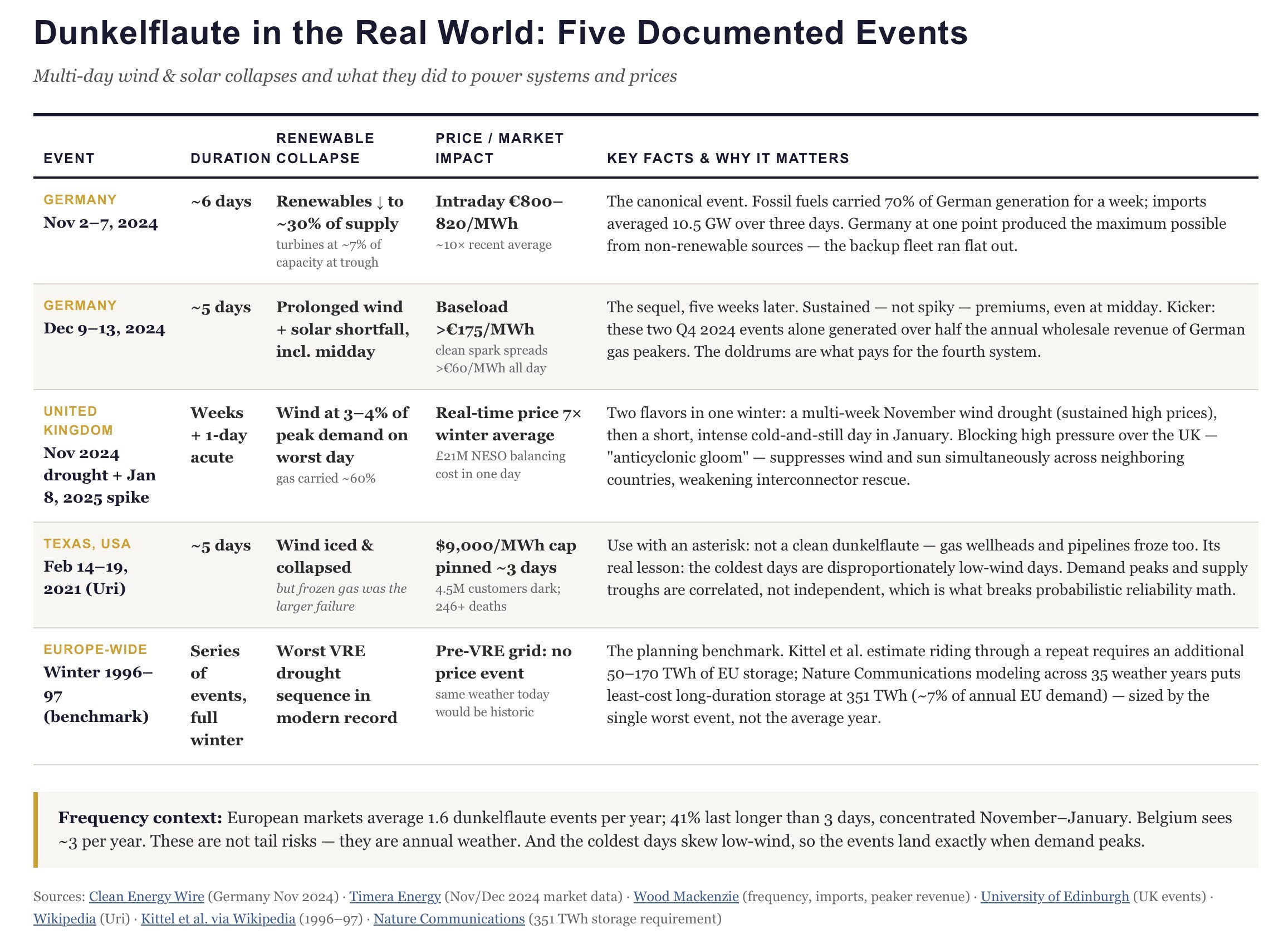
Analysis
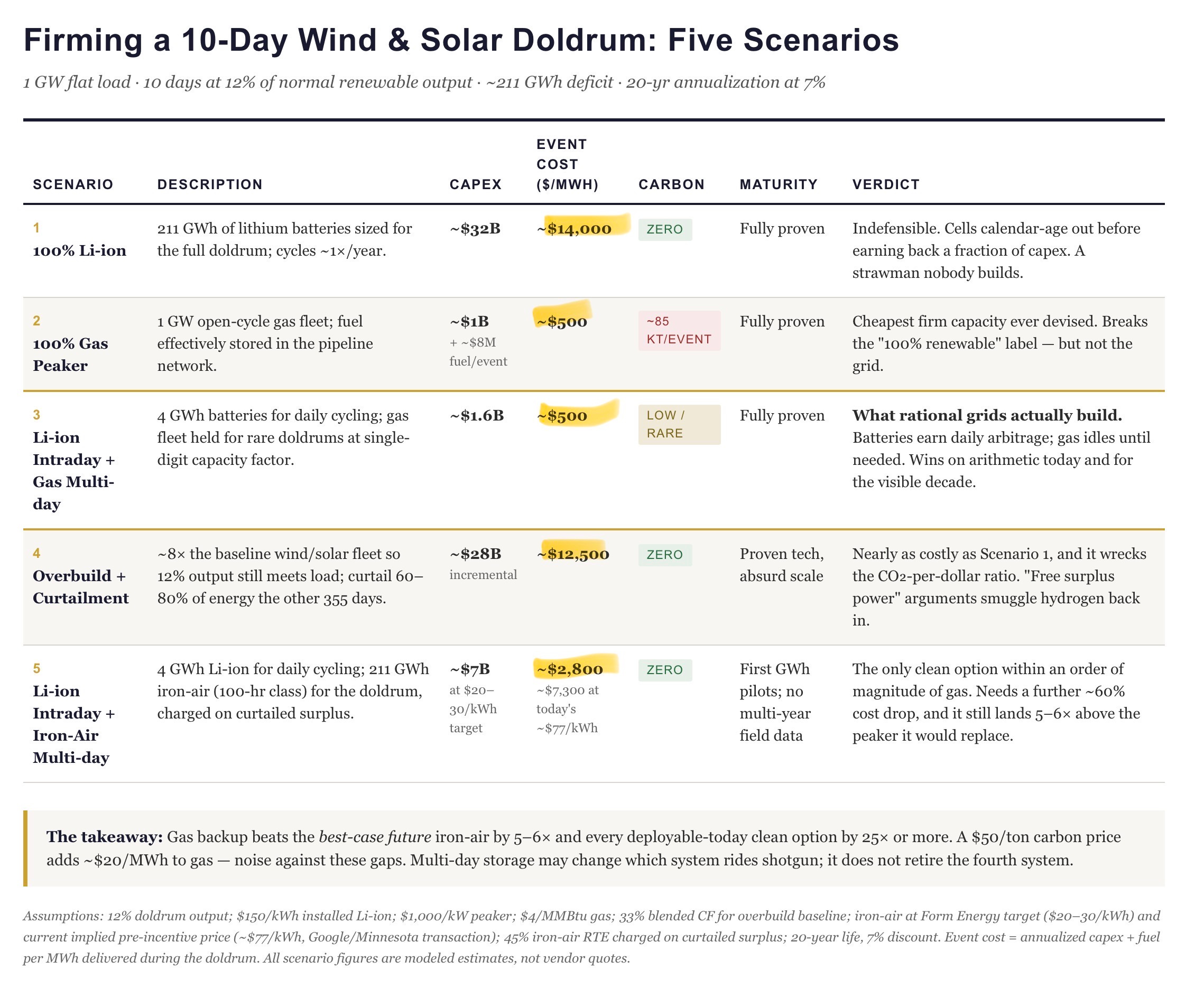
The table below prices five ways to carry a 1 GW load through ten days at 12 percent of normal renewable output — a 211 GWh deficit. The honest metric for an asset that cycles once a year is annualized capital cost per megawatt-hour actually delivered during the event, and on that metric the field separates brutally. Lithium-ion sized for ten days is a $32 billion machine used one week a year. Overbuilding the renewable fleet eightfold costs nearly as much while curtailing most of its output the other 355 days. Iron-air, the only genuine newcomer, would land over 5x more expensive than gas if it hits a target price that today's real transactions still miss by roughly 60 percent. And the gas peaker — the option every rational grid operator quietly builds — delivers the doldrum for about $500 per megawatt-hour, twenty-five times cheaper than any clean alternative deployable today.
The Museum of Long-Duration Grid Storage
Whenever grid battery arithmetic gets uncomfortable, the conversation pivots to a familiar roster of alternatives. Each fails the same test — not of laboratory feasibility, but of scale, cost, and physics. Pumped hydro works, which is why it’s already most of the world’s storage — but it’s a geography lottery, and the good sites were built out generations ago. Hydrogen loses roughly two-thirds of its energy on the round trip, meaning every delivered kilowatt-hour needs nearly three behind it. Gravity storage is a physics lesson: a one-tonne block lifted 100 meters stores 0.27 kilowatt-hours; enough to operate a hairdryer for about 10 minutes.
Thermal storage runs into Carnot — half the energy or more surrendered converting heat back to electricity. Compressed air has been commercial since 1978, and in nearly half a century exactly two utility-scale plants have been built, both burning natural gas to function. Flow batteries, after forty years of development, remain a niche product with an excellent publicist.
The pattern is identical across the board: each technology works in the sense that a prototype functions. None works in the sense that matters — storing days of electricity at a cost the nation can pay. The storage problem isn’t waiting for a breakthrough. It’s waiting for people to do the multiplication.
Conclusions
The doldrums are not a tail risk; they are annual weather, and they arrive precisely when demand peaks. That single fact sets the economics of every high-renewables grid, because reliability is sized by the worst event, not the average year. Today, and for the visible decade, the arithmetic points in one direction: batteries for the day, gas for the doldrum. Iron-air is the first storage technology with a credible claim on the multi-day window, and its progress deserves attention — but even its best-case future closes the gap to “several times more expensive than the peaker it replaces,” not to parity. A multi-day storage breakthrough may someday change which systems stand behind wind and solar. It will not change the fact that one must.
The ratio to remember: Two dunkelflaute events in late 2024 generated over half the annual wholesale revenue of Germany's gas peakers. The dark doldrums don't just justify the backup fleet — they pay for it.
The only solution that is both feasible and economic is the one the tables point to: wind and solar backed by batteries for the day and by natural gas peakers for the multi-day doldrum. But notice what that architecture quietly requires. It is not one system but four — the base wind and solar fleet, the batteries, the additional wind and solar built to charge those batteries, and the gas peaker fleet standing behind them all. Each carries its own capital cost, and each must be paid for whether or not the wind blows. What that four-part machine costs against a single system of nuclear power is the subject of an earlier essay in this series: The Four Systems Problem.
Sources & references:
Clean Energy Wire, “Prolonged ‘Dunkelflaute’ shrinks Germany's renewables output in early November” (Nov 2024) — cleanenergywire.org
Timera Energy, “Impact of German Dunkelflaute on flex asset value” (Jan 2025) — timera-energy.com
Wood Mackenzie, “Weathering the lulls: the risks and opportunities of dunkelflaute” (2025) — woodmac.com
University of Edinburgh / The Conversation, “A flexible energy grid can cope better with Britain's weather” (2025) — impact.ed.ac.uk
Wikipedia, “2021 Texas power crisis” — en.wikipedia.org
Kittel et al. via Wikipedia, “Dunkelflaute” (1996–97 benchmark, 50–170 TWh) — en.wikipedia.org
Kittel, Roth & Schill, “Long-duration electricity storage needs for coping with Dunkelflaute events in Europe,” Nature Communications (2026) — nature.com
Discovery Alert, “Form Energy iron-air battery expansion economics” (Apr 2026; ~$77/kWh implied pre-incentive pricing) — discoveryalert.com.au
Form Energy, “Battery Technology” (100-hour iron-air, <$20/kWh target) — formenergy.com
NREL, “Cost Projections for Utility-Scale Battery Storage: 2025 Update” — osti.gov
Scenario cost modeling (Table 2) by the author: 12% doldrum output; $150/kWh installed Li-ion; $1,000/kW peaker; $4/MMBtu gas; 45% iron-air round-trip efficiency; 20-year life, 7% discount rate. Event cost = annualized capex plus fuel per MWh delivered during the doldrum.
This is an excellent piece because it does the one thing the “wind and solar are cheapest” story cannot survive. It itemizes reliability. Your 1 GW, 10-day calculation makes the cost visible.
The central dodge in renewable economics has always been the use of LCOE as if unreliable and reliable electricity were interchangeable. Lazard’s own description says LCOE “does not take into account reliability-related considerations.” Those considerations are the whole story when a dunkelflaute arrives. Your essay prices exactly what the headline metric excludes. LCOE is cheap because it deletes the dark doldrums. You put them back on the bill.
I also think your “four systems” point is the right structural insight. Calling wind and solar a power system already grants too much. They are an intermittent fuel-saver attached to a real power system. Since they can fall toward zero during the very periods when people still need electricity, they cannot meaningfully reduce the need for reliable capacity. The gas fleet still has to exist, the grid still has to be built, and the capital still has to be paid for. The honest comparison is the reliable grid we need anyway, plus an optional weather-dependent layer that sometimes saves fuel and never eliminates the underlying system.
Your line that “the storage problem isn’t waiting for a breakthrough. It’s waiting for people to do the multiplication” is exactly right. I would add that the multiplication has been actively avoided. An entire policy and finance apparatus depends on treating intermittency as someone else’s problem and reliability as an external detail.
The most important fact in your piece may be that the backup fleet is the indispensable power source when the weather system fails. That is the fact the “cheaper than fossil fuels” narrative is built to avoid.
Too often the most fervent supporters of renewable energy fail to mention the need for taking care of tail events and the cost of the “insurance” for those events (events that like you stated are not really tail events anymore). Or there is the deflection of blame (in Texas during Uri, the gas and nuclear plants failed to deliver, in Spain the fault was with nuclear and other thermal plants, look at France having to shut down nuclear plants because of the warm weather and cooling water is above a prescribed temperature). I am all in support of more clean energy and wind and solar play a critical role in this , but then account for the full costs, be prepared to talk about capacity factors, so that the full picture is shown to the public. At present, it seems the emphasis is as much if not more on energy security, regardless of the energy source, and if solar and wind can provide this security, so much for the better. It is regrettable though that in some countries the government is doubling down on getting rid of nuclear energy as a reliable energy source, intent on continuing the mistakes that were made after in particular Fukushima (just look at Spain deciding to shut down a well functioning plant like Almaraz, Germany struggling with their energy supply from clean sources). And finally, I wish we could all start to use “clean energy” as a phrase rather than “renewable”. Are many sources of biofuels really renewable, like many claim, can folks really claim that the fuel for nuclear plants is not not renewable? We have thousands of years of uranium and thorium, even though mining is a challenge. But so is sourcing and mining for the materials used to make solar panels, wind turbines etc.