The Four-System Problem
The true cost of displacing nuclear with wind and solar, counted completely and honestly for the first time

The Undeclared Bet
There is a distinction in energy policy between what is stated and what is revealed. No serious energy agency officially claims that wind and solar alone can power a modern economy. The IEA’s own Net Zero pathway reserves a meaningful role for nuclear, and academic literature on deep decarbonization consistently identifies firm, dispatchable power as an irreducible requirement. And yet since 2000, the United States and Europe have added roughly 930 gigawatts of wind and solar nameplate capacity while simultaneously decommissioning approximately 50 gigawatts of nuclear — firm, zero-carbon, always-on power that no wind turbine or solar panel can replicate. More than a dozen U.S. states have enshrined “100% clean energy” mandates in law, with the operative definition pointing explicitly to wind and solar. Not a single Western nation is building nuclear at a pace that would maintain, let alone expand, its share of the grid. In economics, the term for this is revealed preference: what you actually do tells the truth that your stated intentions cannot.
The West has decommissioned 50 gigawatts of nuclear since 2000 while adding 930 gigawatts of wind and solar nameplate — by default, wind and solar are our decarbonization policy
Judged by twenty-five years of capital allocation, permitting decisions, and legislative mandates, the West has not been pursuing a diversified clean energy transition. It has been making an undeclared bet — enormous in scale, unproven at full deployment, and structurally dependent on a gas backstop nobody wants to acknowledge — that wind and solar are, in fact, the whole answer.
The Standard of Comparison
To move from principle to arithmetic, consider a single, concrete question: what does it actually cost to displace one nuclear power plant? Not in talking points or megawatt nameplate figures, but in the full engineering and financial reality of matching what nuclear delivers. The U.S. nuclear fleet operates at an average capacity factor of 93.5% — meaning a 1-gigawatt reactor produces roughly 8,147 gigawatt-hours of electricity every year, reliably, regardless of weather, season, or time of day. It does this for sixty years on a single capital investment, with no replacement of the core asset and no backup system required. That is the standard of performance any replacement must meet. This analysis attempts to meet that standard honestly — building each alternative technology system from the ground up, component by component, priced at sourced 2025 costs, and evaluated not just at the moment of construction but across a full sixty-year operating life. The numbers that emerge are not an argument against renewable energy in principle. They are a precise accounting of what the energy transition actually costs when the accounting is done completely.
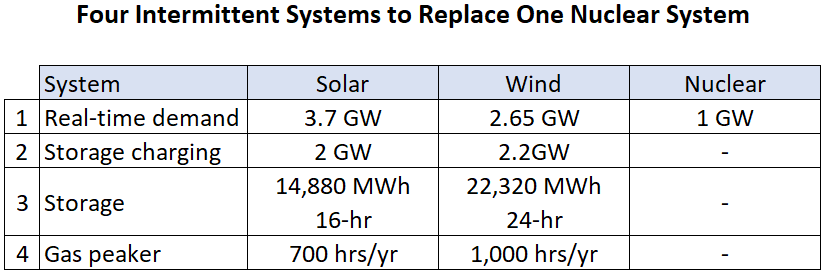
Table - All configurations deliver firm 930 MW at 93% capacity factor — the U.S. nuclear fleet average (EIA 2023). Solar CF: 25%; Wind CF: 35% (NREL ATB 2024). Battery duration sized to bridge average generation gap: 16 hrs solar (PV Magazine/ISES 2026), 24 hrs wind. Gas peaker mandatory — no commercially viable long-duration storage alternative exists (Wood Mackenzie 2026).
SOLAR: Four systems to displace one
Replacing a single 1-gigawatt nuclear plant with solar power requires not one system but four, each essential, none optional. The first is base generation: 3.7 gigawatts of solar panels to produce, on average, the required 930 megawatts of output at a 25% capacity factor — nearly four times the nameplate capacity of the nuclear plant being displaced. The second is a charging overbuild: an additional 2.0 gigawatts of panels whose sole purpose is to charge the battery system fast enough during peak sun hours to cover the coming night, bringing total installed solar nameplate capacity to 5.7 gigawatts. The third is storage: a 16-hour lithium-ion battery system holding 14,880 megawatt-hours — sized to bridge the average overnight gap when no solar generation is possible. And the fourth, which no policy document advertises but every honest engineer acknowledges, is a natural gas peaker plant: 800 megawatts of simple-cycle combustion turbine capacity, standing ready for the multi-day stretches of cloud cover, seasonal low-sun periods, and compounding weather events that a 16-hour battery cannot survive. Together, these four systems cost between $16.7 billion and $21.5 billion to build today. Maintained and replaced across a 60-year life — with three full battery replacements, two full panel replacements, and one gas turbine replacement, all at today’s prices — the net present value of the complete system reaches $20.8 billion to $26.6 billion. The nuclear plant it displaces costs $3.0 billion to $4.7 billion, requires no storage, no backup, and no replacement.
The wind system’s battery alone costs more to build than the entire nuclear plant.
WIND: The storage problem gets worse
Replacing the same 1-gigawatt nuclear plant with onshore wind requires the same four-system architecture as solar, with one critical difference: the storage problem is worse. Wind’s average U.S. capacity factor of 35% is higher than solar’s 25%, which means fewer turbines are needed for base generation — 2.65 gigawatts compared to solar’s 3.7. But wind’s variability is fundamentally less predictable than solar’s. The sun reliably sets and reliably rises; wind droughts are irregular, multi-day, and in some regions seasonal. A 16-hour battery that bridges a predictable overnight gap has no equivalent for wind. The battery must be sized to 24 hours — 22,320 megawatt-hours of lithium-ion storage — and even that is an engineering assumption, not a guarantee. The recharge overbuild climbs to 2.2 gigawatts, bringing total installed nameplate to 4.85 gigawatts. The mandatory gas peaker grows to 900 megawatts and operates an estimated 500 to 1,000 hours per year, nearly twice the frequency of its solar counterpart, because wind droughts are longer and less predictable than nights. Together, these four systems cost between $16.5 billion and $22.0 billion to build. Across a 60-year life — with the same replacement schedule of three battery cycles, two turbine cycles, and one gas turbine refresh — the net present value reaches $21.4 billion to $28.1 billion. The nuclear plant it displaces still costs $3.0 billion to $4.7 billion.
NUCLEAR: One system, six decades, no replacements
And then there is nuclear. A single 1-gigawatt reactor, built to South Korean or Chinese proven construction standards, delivers 8,147 gigawatt-hours of electricity per year at 93.5% capacity factor — firm, dispatchable, weather-independent power available at any hour of any day in any season. It requires no battery. It requires no gas peaker. It requires no recharge overbuild, no meteorological forecasting system, no multi-day drought contingency, and no fuel supply hedging strategy beyond a periodic uranium delivery that costs roughly $6 to $9 per megawatt-hour — less than the variable cost of running the gas peaker it eliminates. The entire capital cost of the plant, including transmission and interconnection, falls between $3.0 billion and $4.7 billion. That figure does not change over sixty years. There are no replacement cycles. There are no battery augmentation costs billed annually to maintain rated capacity. There is no Year 15 reckoning, no Year 30 turbine refresh, no Year 45 battery swap. The asset built on day one is the asset operating on day 21,900. Against the solar system’s 60-year net present value of $20.8 billion to $26.6 billion — or the wind system’s $21.4 billion to $28.1 billion — nuclear’s lifecycle cost of $3.0 billion to $4.7 billion represents a capital efficiency advantage of roughly five to one at the midpoint. That is not a rounding error. It is not a modeling artifact. It is the arithmetic consequence of building a machine that works continuously for six decades without asking to be rebuilt.
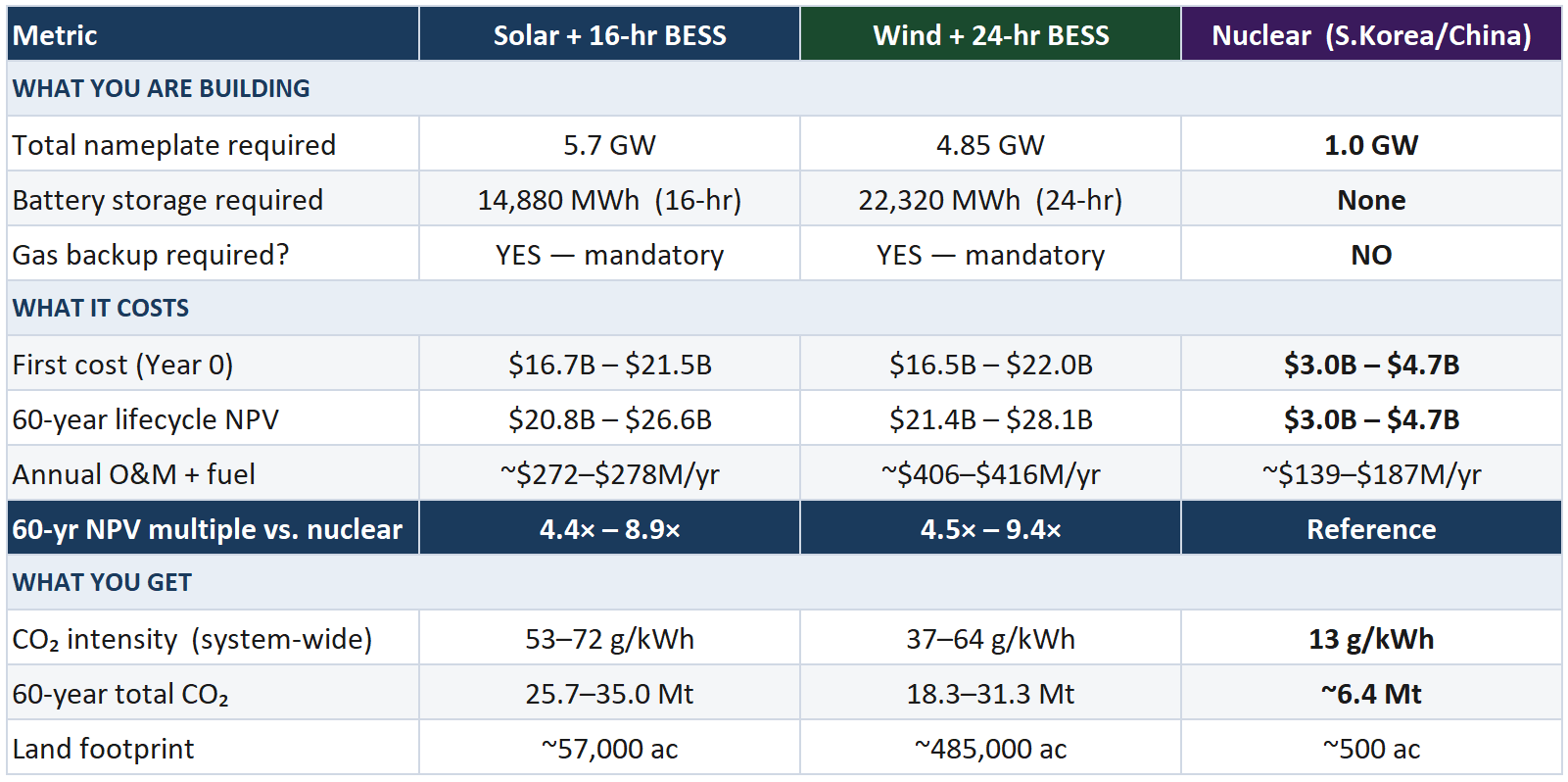
Table 1 — The Four-System Problem: 60-Year Lifecycle Summary | Firm 1 GW at 93% CF | All costs 2025 USD, NPV @ 7%
What the Numbers Actually Say
Set side by side, the three systems tell a story that no amount of policy enthusiasm can arithmetic away. To deliver one gigawatt of firm, continuous power at the reliability standard the U.S. nuclear fleet has maintained for decades, solar requires 5.7 gigawatts of installed nameplate capacity, a 14,880 megawatt-hour battery, a natural gas plant, and a capital investment that over sixty years runs to $20.8 billion to $26.6 billion. Wind requires 4.85 gigawatts of nameplate, a larger 22,320 megawatt-hour battery, a larger gas plant that runs twice as often, and a sixty-year cost of $21.4 billion to $28.1 billion. Nuclear requires one gigawatt of nameplate capacity, no battery, no gas plant, and $3.0 billion to $4.7 billion — once, for six decades.
The annual operating costs follow the same pattern: solar systems run approximately $258 million per year to maintain, wind $382 million, nuclear $163 million. Expressed per megawatt-hour of actual output — the only fair basis for comparison across systems of very different sizes — solar costs roughly $31.60/MWh to operate, wind $46.80/MWh, and nuclear $20.00/MWh. Nuclear’s per-unit operating cost is lower than either renewable system despite carrying the full burden of staffing, security, regulatory compliance, and fuel handling that solar and wind do not. The solar peaker burns an estimated $14 to $20 million worth of natural gas every year; the wind peaker, running nearly twice as many hours, burns $24 to $34 million. Discounted over sixty years, those fuel streams add roughly $200 to $280 million to solar’s lifecycle cost and $330 to $470 million to wind’s — at today’s gas prices. When Henry Hub spiked to $8.80 per MMBtu in the summer of 2022 and touched $9.86 on a single day in 2025, those fuel bills roughly tripled. Nuclear carries no equivalent exposure: its uranium fuel costs $6 to $9 per megawatt-hour and has never experienced a supply disruption remotely comparable to a continental gas price spike.
On carbon, the gap is equally instructive. The solar system — including its mandatory gas backstop — emits 53 to 72 grams of CO₂ per kilowatt-hour over its lifecycle. Wind emits 37 to 64. Nuclear emits 13. The systems advertised as the solution to carbon emissions produce four to five times more carbon per unit of energy than the technology they are replacing. Across sixty years of full operation, the solar system releases 25 to 35 million tonnes of CO₂. Wind releases 18 to 31 million tonnes. Nuclear releases 6.4 million tonnes — and every tonne of that is embodied in construction materials and supply chain, not a single molecule burned in operation.
On land, the contrast is as stark as on carbon. The solar system requires approximately 57,000 acres — nearly 90 square miles of terrain permanently removed from any other use. The wind system demands 485,000 acres — roughly 760 square miles — though the land beneath the turbines remains farmable. Nuclear requires approximately 500 acres, including its federal exclusion zone. The solar footprint is 114 times larger than nuclear’s. The wind footprint is 970 times larger. These are not modeling assumptions. They are the physical consequence of collecting diffuse energy across a vast surface rather than releasing dense energy from a compact fuel.
Both renewable systems are gas-fired. Neither qualifies as firm clean power.
What about Cheaper Panels and Batteries?
The most common rejoinder to this kind of analysis is that solar panels and battery cells keep getting cheaper, and that projecting today’s costs forward misses the trajectory. It is a fair point, and it deserves an honest answer. This analysis holds all costs at 2025 prices throughout — precisely to avoid the speculative territory of technology forecasts. But as a separate exercise, the sensitivity table that accompanies this essay asks the question directly: how much does the cost gap narrow if panel modules and battery cells fall in price? The answer is instructive. Panel modules represent approximately 42% of installed solar generation cost; battery cells represent approximately 60% of the battery energy component. Everything else — racking, inverters, civil works, wiring, labor, transmission, land, permitting, and contingency — does not move with manufacturing learning curves. Those components together account for roughly 70% of the total system cost. The arithmetic consequence is that even a 50% additional reduction in both panel and cell costs simultaneously reduces the solar system’s first cost by approximately $2.9 billion, from $19.1 billion to $16.2 billion at the midpoint. The multiple vs. nuclear narrows from 5.0 times to 4.2 times. The dollar gap shrinks from $15.2 billion to $12.4 billion. At a 70% reduction in both components, the multiple reaches 3.9 times and the gap is $11.2 billion. Nuclear, meanwhile, does not get more expensive in these scenarios — its cost is independent of panel and cell pricing. The gap narrows, but it does not close. The structural advantage of building one system instead of four, with no replacement cycles and no gas backstop, is not a function of where panels trade on the spot market.
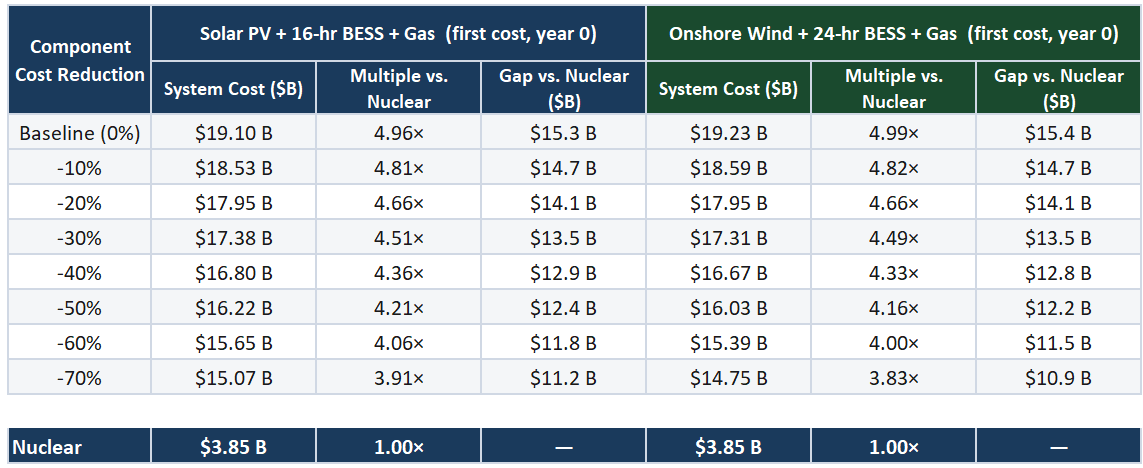
Table 2 — Sensitivity Analysis: How Much Does the Cost Gap Close? Panel and Cell Cost Reductions Applied to Solar and Wind First Cost (Year 0)
The Question We Refuse to Ask
None of this is an argument that nuclear is easy, or cheap by the standards of recent Western construction, or without legitimate questions of waste, safety, and regulatory complexity that serious people have debated for half a century. Vogtle proved, painfully, what happens when the United States tries to build nuclear without the institutional knowledge, supply chain depth, and regulatory predictability that South Korea and China have spent decades cultivating. At roughly $16,000 per kilowatt all-in, Vogtle stands as a monument to what happens when a nation loses the ability to build the things it once knew how to build. Those are real constraints, and they deserve honest engagement rather than dismissal. But they are constraints on deployment, not on physics.
The physics — and the arithmetic — are not in dispute. A firmed solar system costs four to nine times more than nuclear over sixty years, requires 114 times more land, and emits four to five times more carbon per kilowatt-hour. A firmed wind system costs roughly the same multiple, demands 970 times more land, and still burns gas every time the wind stops blowing. These are not the characteristics of a replacement technology. They are the characteristics of an improvisation — expensive, land-hungry, carbon-leaking, and structurally dependent on the fossil fuel it was supposed to displace.
The West has spent twenty-five years and trillions of dollars building that improvisation while systematically dismantling the one technology that actually delivers firm, zero-carbon power at scale. The question is not whether wind and solar have a role in a rational energy system. They do. The question is whether displacing nuclear with wind and solar — at five times the cost, on a hundred times the land, with a gas plant running in the background — was ever a serious plan for decarbonization. The numbers say it was not. So what is the plan for nuclear?
The Detailed Models and Assumptions

Sources & References
Sources and references: Wind/solar additions since 2000: EIA (U.S. wind 2.4→150 GW); WindEurope 2024 (EU wind 285 GW, was 12.9 GW in 2000); IRENA/SolarPower Europe 2025 (EU solar 338 GW in 2024; U.S. solar 176 GW). Nuclear decommissioned: MIT CEEPR 2017; IWR Renewable Energy Industry 2025; EIA nuclear retirement data; Agora-Energiewende 2025 (Germany). U.S. state 100% clean energy mandates: Environment America; NCEL State Climate Policy Dashboard. Nuclear capacity factor 93.5%: EIA Electric Power Monthly 2024. https://www.eia.gov/electricity/monthly/ Solar CF 25% / wind CF 35%: NREL ATB 2024. https://atb.nrel.gov/electricity/2024/utility-scale_pv | LBNL Land-Based Wind Market Report 2024. Solar installed cost $1,400–$1,610M/GW: LBNL Utility-Scale Solar 2025. https://emp.lbl.gov BESS cost formula and 15-yr life: NREL ATB 2024; NREL Cost Projections for Utility-Scale Battery Storage 2025. https://atb.nrel.gov/electricity/2024/utility-scale_battery_storage | https://docs.nrel.gov/docs/fy25osti/93281.pdf 16-hr solar night average: PV Magazine/ISES February 2026. https://www.pv-magazine.com/2026/02/25/solar-electricity-during-night-time/ No viable LDES alternative: Wood Mackenzie/Utility Dive March 2026. https://www.utilitydive.com/news/long-duration-energy-storage-deployments-rose-49-in-2025-woodmac/814336/ Multi-day energy droughts: PNNL/Bracken et al. 2024. https://www.pnnl.gov/news-media/even-months-long-energy-droughts-power-grid-remains-resilient | Handschy, Rose, Apt 2016, Carnegie Mellon/Enduring Energy. Gas CT cost $728–$1,544/kW: GridLab 2025. https://gridlab.org/wp-content/uploads/2025/09/GridLab_Gas-Turbine-Costs-Report-1.pdf Gas CT heat rate 10 MMBtu/MWh: EIA AEO 2023. https://www.eia.gov/outlooks/aeo/assumptions/pdf/elec_cost_perf.pdf Transmission $2–$5M/mile: MISO MTEP24. https://cdn.misoenergy.org/20240501%20PSC%20Item%2004%20MISO%20Transmission%20Cost%20Estimation%20Guide%20for%20MTEP24632680.pdf Henry Hub 2025 avg $3.52/MMBtu; spike $8.80 Aug-2022; $9.86 daily high 2025: EIA STEO. https://www.eia.gov/todayinenergy/detail.php?id=66984 | https://www.eia.gov/todayinenergy/detail.php?id=54599 Nuclear capital S. Korea ~$3,143/kW (Shin Hanul 3&4): Neutron Bytes 2024. https://neutronbytes.com/2024/09/14/south-korea-to-complete-two-reactors-at-shin-hanul/ Nuclear capital China ~$2,753/kW (Jinqimen 1&2): NucNet 2024. https://www.nucnet.org/news/construction-of-two-hualong-one-nuclear-plants-begins-at-jinqimen-2-2-2024 Nuclear fuel $6–$9/MWh: World Nuclear Association. https://world-nuclear.org/information-library/economic-aspects/economics-of-nuclear-power | NREL ATB 2024. Solar/wind O&M: NREL ATB 2024 ($24/kW-AC/yr); NREL Cost of Wind Energy Review 2024 ($43/kW/yr). https://docs.nrel.gov/docs/fy25osti/91775.pdf Nuclear O&M: NREL ATB 2024; Net Zero World Initiative 2024. CO₂ lifecycle: NREL LCA Harmonization 2021. https://docs.nrel.gov/docs/fy21osti/80580.pdf | IPCC AR5 (gas CT 490 g/kWh). Vogtle 3&4 ~$36B / 2.234 GW = ~$16,100/kW: AP/Georgia Public Broadcasting April 2024. https://www.gpb.org/news/2024/04/29/second-new-nuclear-reactor-completed-in-georgia-the-carbon-free-power-comes-at-high IEA Net Zero 2050: https://www.iea.org/reports/net-zero-by-2050 Contingency 20–25% for renewables: independent peer review, June 2026.
Great job. Definitely a resource I will quote. Thank you.
Thank you Scott: your masterful piece brought to mind David Mackay (sadly no longer with us), Cambridge physicist and author of ‘Sustainable energy without the hot air’ (downloadable free here: https://www.withouthotair.com/) and the quote: I'm not trying to be pro-nuclear. I'm just pro-arithmetic”.