The Star that Never Rises
Fusion energy has been twenty years away for seventy years. The physics explains why. The money explains why we keep believing otherwise.

On the morning of December 13, 2022, the United States Department of Energy convened a press conference. Secretary Jennifer Granholm stood before cameras alongside the nation’s top science advisers and announced what she called “a landmark achievement.” Physicists at the National Ignition Facility in Livermore, California had done it — they had produced more energy from a fusion reaction than they had put in. The headlines wrote themselves. “Scientists Achieve Nuclear Fusion Breakthrough,” said The New York Times. “U.S. Announces Milestone on Fusion Energy, Sparking Hopes for Clean Power,” said The Washington Post. “Scientists Reveal ‘Holy Grail’ Breakthrough to Create ‘Limitless Clean Energy,’” said The Mirror. The BBC announced a “Breakthrough in Nuclear Fusion Energy.” In the first week, media tracking logged more than 103,000 news mentions across print and digital outlets, reaching audiences in 199 countries. Saturday Night Live ran a sketch. ESPN wrote a column about it.
There was one number that did not make any of those headlines.
It is like a football team celebrating a first down on their own one-yard line and calling a press conference. The play was real. The gain was real. They still have 99 yards to go. The National Ignition Facility drew between 300 and 400 megajoules of electricity from the grid to run the experiment — confirmed by LLNL’s own chief scientist in a subsequent briefing to the International Atomic Energy Agency. Of that, just 2.05 megajoules actually reached the target pellet, a sphere roughly the size of a BB. That pellet released 3.15 megajoules of fusion energy — more than the lasers delivered to it. That is the number the Department of Energy announced. That is the number that produced the headlines. But measured against the total electricity the facility consumed to generate that result, the ratio was between 0.008 and 0.010 — meaning for every single unit of fusion energy produced, the facility burned through 100 to 130 units of electrical energy to get there. That ratio is what physicists call the wall-plug gain, or Qᵂₚ. It is the number that determines whether a fusion plant can actually power a city. And it is the number that appeared in none of the headlines.
for every single unit of fusion energy produced, the facility burned through
100 to 130 units of electrical energy to get there
This is not a criticism of the physicists at Livermore, who do remarkable science. It is a criticism of a communications system — government, industry, scientific institutions and media working in loose concert — that has spent seven decades telling a story about fusion that the physics does not yet support. And it matters enormously, because the story shapes policy, attracts capital, and, perhaps most dangerously, provides a psychological escape hatch from the hard choices that decarbonization actually requires.
Two Numbers, One Inconvenient Truth
The gap between the headline and the reality comes down to two definitions of the same concept — and which one you choose to report.
Qsci, or scientific gain, is the number laboratories officially report. It measures the ratio of fusion energy produced by the plasma to the heating energy injected directly into that plasma — and nothing else. The electricity consumed to power the lasers, the magnets, the cooling systems, the control room: none of that is counted. As physicist James McKenzie wrote in New Energy Times (2022), Qsci “does not consider the electrical power required to produce the heating power.” But it is the number NIF reported in December 2022. It is the number that produced the headlines. It is what ITER, the $25-billion tokamak under construction in France, is designed to achieve at a value of roughly ten.
Qwp, or wall-plug gain, counts everything. It measures the ratio of fusion energy produced to every joule of electricity drawn from the grid — the lasers, the magnets, the cooling, the controls, all of it — from the moment the facility powers up to the moment the shot fires. Wurzel and Hsu, whose 2022 paper in Physics of Plasmas is the authoritative cross-facility compilation of fusion gain data, define Qwp as “the ratio of fusion power to total input electrical power” — the full accounting, no exclusions. It is the number that determines whether a fusion plant can actually power a city. And it is the number the fusion industry almost never mentions in public.
(Note for readers familiar with the technical literature: Qwp and Qeng, or engineering gain, are often used interchangeably in the literature — both refer to total facility electrical input versus fusion energy output. This essay uses Qwp throughout.)
The gap between these two numbers is structural, not incidental. NIF’s lasers convert grid electricity to laser light at roughly 1% efficiency. Tokamaks require enormous power to maintain superconducting magnets and heating systems. Trace every electron from the wall socket to the reaction and back, and the numbers collapse. And that is before accounting for the journey to electrons out: fusion produces heat, not electricity, and converting that heat through a steam turbine to reach the grid runs at roughly 40% efficiency. The energy bleeds away at both ends of the chain. The best wall-plug gain ever recorded — a researcher-estimated Q_wp of approximately 0.010 at JET in 1997 — has not meaningfully improved in nearly thirty years. The commercial viability threshold is generally estimated at Q_wp of five to ten. The best result in history sits 500 to 1,000 times below that floor.
Seventy Years on the Learning Curve
The chart below tells the story the industry’s press releases do not. In 1997, JET set the all-time Q_wp record of approximately 0.010. The number then fell. Two decades of billions of dollars invested, ITER’s construction, and the birth of the private fusion industry produced wall-plug gains clustered around 0.003. NIF’s celebrated 2022 ignition shot registered roughly 0.008. Progress in plasma physics has been real. Progress in the number that determines whether fusion can power a city has been, at best, modest. This is the chart the fusion industry does not put in its investor decks.
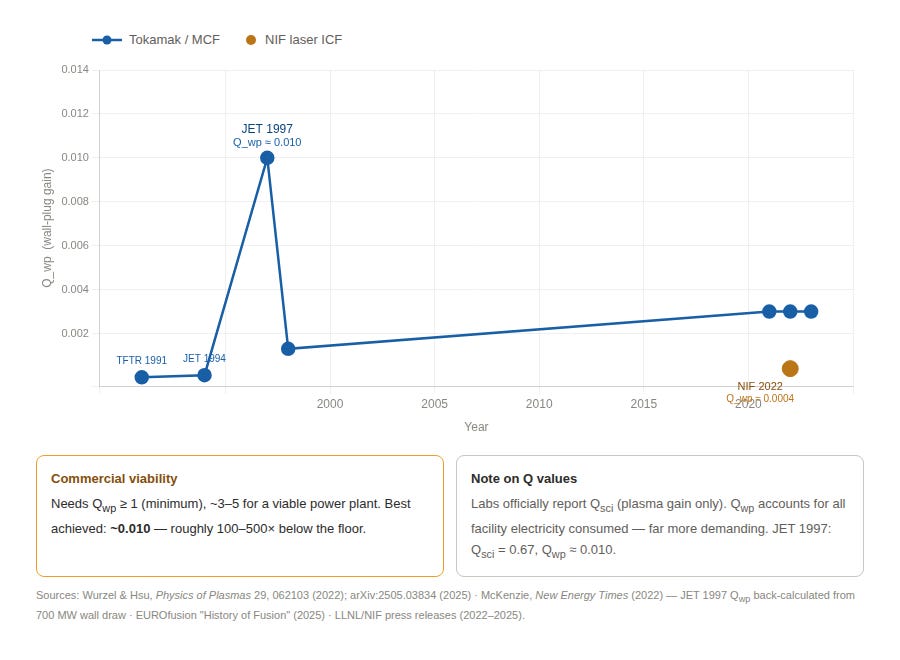
Figure 1. Fusion wall-plug gain (Qᵂₚ) — historical milestones. All Qᵂₚ values are researcher estimates; labs officially report Qₛᴄᴵ. Sources: Wurzel & Hsu (2022, 2025); McKenzie (2022); EUROfusion (2025); LLNL/NIF press releases.
The standard industry response is that wall-plug gain is unfair for an experimental program never designed to be a power plant. This is true. It is also a description of the problem, not a refutation of it. ITER will not generate electricity. SPARC, Commonwealth Fusion Systems’ compact tokamak under construction in Massachusetts, targets Q_sci greater than two — genuine progress — but also generates no power. ARC, the actual power-producing design, is a concept targeting the early 2030s built on a chain of assumptions that have never been validated at scale.
The Fuel Problem Nobody Talks About
Even setting aside the Q_wp gap, fusion faces a supply problem that receives almost no attention in popular coverage. Every fusion device capable of meaningful energy output runs on a mix of deuterium and tritium. Deuterium is abundant — it can be extracted from seawater. Tritium is not. It is a radioactive isotope of hydrogen with a half-life of just 12.3 years, meaning it decays too quickly to stockpile. The entire global supply, produced as a byproduct in a small number of CANDU fission reactors, is measured in kilograms. According to MIT’s Plasma Science and Fusion Center, a single commercial fusion power plant would consume all of Earth’s existing tritium reserves within a year.
The proposed solution is a lithium breeding blanket — a layer of lithium surrounding the reactor that captures fusion neutrons and converts them into new tritium. In theory, a reactor breeds its own fuel. In practice, no fusion device has ever demonstrated tritium breeding at anywhere near the ratio required for self-sufficiency. The most recent experimental measurement of tritium breeding ratio, published by MIT in 2025, achieved a result four orders of magnitude — ten thousand times — below what a commercial plant would require. The breeding blanket is not an engineering detail to be solved later. It is an unsolved core problem that must work before the first commercial plant can operate — and it has never been demonstrated at scale.
The Hype Machine
There is an old joke that fusion has been thirty years away for sixty years. It has now been thirty years away for seventy. The difference today is the money: more than $9.7 billion in private investment across approximately fifty companies, with pitch decks to match.
Sam Altman, chairman of Helion Energy and CEO of OpenAI, told Bloomberg in January 2025 that “fusion’s gonna work” within a few years. In November 2021, Helion’s own press release — announcing a $500 million fundraise led by Altman — committed to demonstrating net electricity from fusion by 2024. 2024 came and went. The timeline has since been revised to 2028, and Microsoft, which signed a power purchase agreement for Helion electricity by 2029, presumably updated its assumptions quietly.
Commonwealth Fusion Systems, the best-capitalized private fusion company with nearly $3 billion raised, targets a commercial ARC plant in the early 2030s. Google has signed to purchase 200 megawatts from it. TAE Technologies, which has raised $1.79 billion, announced in December 2025 it would merge with Trump Media & Technology Group in a deal valued at approximately $6 billion. The fusion industry has always had an elastic relationship with timelines. It now also has an elastic relationship with corporate identity.
The pattern is not new. Fusion has promised commercial power within a decade since the 1970s. Bold near-term claim, quiet revision, new bold near-term claim, repeat. What is new is the scale of capital riding on that structure.
The media has been a willing amplifier. The December 2022 coverage did not explain the difference between the plasma gain number and the wall-plug reality, did not note that NIF consumed 100 to 130 units of energy for every unit produced, and ran the Department of Energy’s framing almost verbatim: “holy grail,” “limitless clean energy,” “breakthrough.” The result is a public that believes fusion is nearly solved rather than a long-range research program with genuinely uncertain commercial prospects.
EROEI: Putting Fusion in Context
In a previous essay in this series, we introduced a framework that applies with particular force to the fusion question: Energy Return on Energy Invested, or EROEI. The metric is simple. Divide the energy a source delivers over its lifetime by the energy required to build, fuel, operate, and decommission it. The result tells you how much surplus energy that source contributes to civilization — the energy left over for hospitals, schools, manufacturing, and every other thing society does beyond keeping itself powered.
Modern civilization requires an EROEI of at least 7:1 to sustain industrial complexity. The table below places the major energy sources on the same scale — and fusion alongside them.
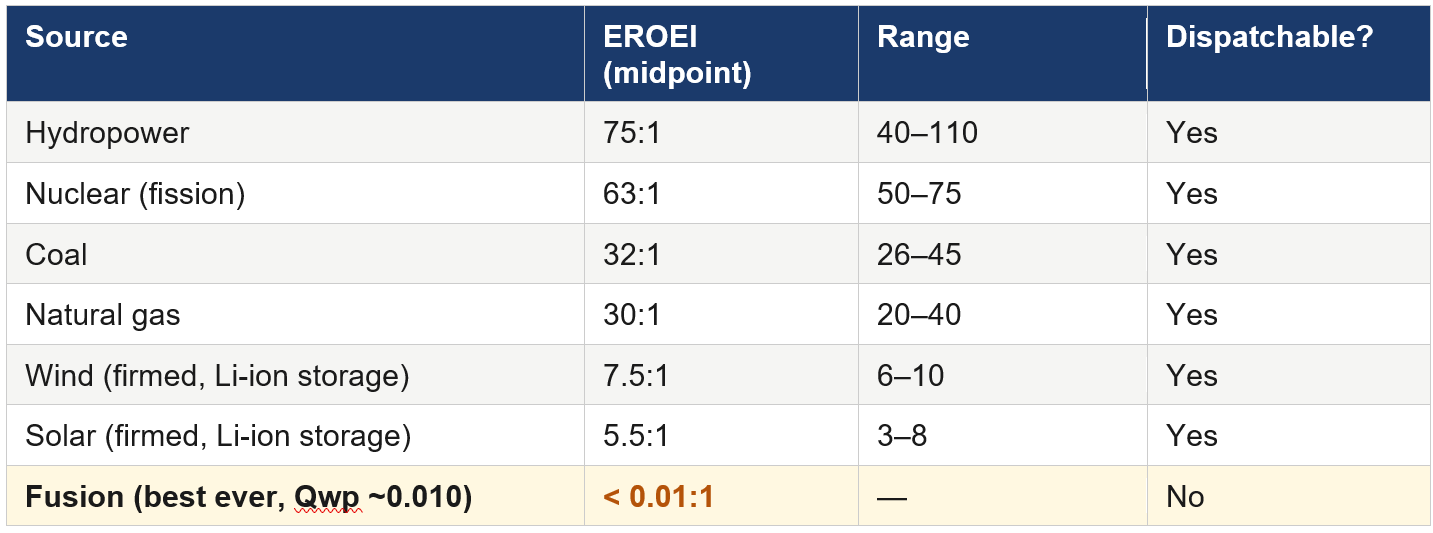
Sources: Weissbach et al. (2013); Barnhart & Benson (2013); Hall et al. (2009); Lambert et al. (2014); Wurzel & Hsu (2022). Fusion EROEI row derived from researcher-estimated Qᵂₚ values and ~40% thermal conversion efficiency; no lab officially reports Qᵂₚ.
Fission and hydro operate at EROEI levels thousands of times higher than fusion’s best recorded result. That is the gap — not in plasma physics, but in the arithmetic that determines whether a technology can power a civilization.
A Pattern We Have Seen Before
The fusion hype cycle is the latest chapter in a longer story: energy policy distorted by advocacy disguised as analysis, timelines driven by fundraising rather than physics, and a media environment that rewards excitement over accuracy.
Western energy policy spent thirty years sidelining the one dispatchable, zero-carbon technology with an EROEI of 50 to 75 that can be built anywhere on Earth. Nuclear fission’s liabilities are well, if not over-expressed — waste, un-necessary cost overruns, unfounded public anxiety — but its energy economics are extraordinary. Germany closed functioning nuclear plants and replaced them with natural gas. California did the same. The results were predictable to anyone willing to look at the numbers.
Fusion is now positioned as the answer to the problems the rejection of fission created. The narrative is seductive: the real solution — clean, limitless, always-on — is just around the corner. Thirty years, maybe twenty. Maybe ten, if Sam Altman is right. He has not been right so far, on almost anything. The danger is not that people believe in fusion — the science is real and deserves funding. The danger is that fusion belief functions as a permission structure, a reason to defer the choices that decarbonization requires right now, with technologies that actually exist.
What Realism Requires
The energy system that powers civilization is not built on hope. It is built on surplus — the energy left over after the energy sector feeds itself. Every unit of that surplus funds a hospital, a school, a factory. The world needs dispatchable, zero-carbon power on a timeline measured in years, not generations. The technologies that can deliver it — fission and hydropower primarily — are available now, proven at scale, and carry EROEI profiles that comfortably clear the societal minimum. They are not exciting. They do not attract investments from the chairman of OpenAI or merge with the President of the United States’ social media company. But they work.
We have been through this before — the overclaiming, the compressed timelines, the policy decisions made on projections the underlying energy economics did not support. The path forward is not to repeat the pattern with a more glamorous technology. It is to make decisions grounded in what the numbers say and stop using the dream of the perfect as a reason to defer the deployment of the good.
The star at the center of our solar system has been fusing hydrogen for five billion years. It is extraordinarily good at this. The facility in Livermore is not the sun. It consumed between 300 and 400 megajoules to produce 3.15. The Department of Energy called it a landmark achievement. In the narrow, specific, carefully defined terms of plasma physics, it was.
In the terms that determine whether the lights stay on, we have a very great deal more work and fundamental invention to do.
SOURCES
1. Wurzel, S.E. & Hsu, S.C. (2022, updated 2025). “Progress toward fusion energy breakeven and gain as measured against the Lawson criterion.” Physics of Plasmas 29, 062103; arXiv:2505.03834. arxiv.org/abs/2505.03834
2. McKenzie, J. (2022). “Fusion Q-Values and Breakeven Explained.” New Energy Times, April 2022. news.newenergytimes.net/2022/04/08/fusion-q-values-and-breakeven-explained/
3. Weissbach, D. et al. (2013). “Energy intensities, EROIs, and energy payback times of electricity generating power plants.” Energy 52: 210-221. doi.org/10.1016/j.energy.2013.01.029
Excellent article. One of the challenges the industry realists may face is perception versus reality and exciting versus kind of boring in educating our younger generation (but also politicians), unburdened by deep knowledge. Fusion sounds exciting, fission seems so boring (if some politicians even grasp the difference). And of course who is going to invest in a SPAC or IPO if the investor deck states there is only a 10% chance of successful commercial operation by 2035. I agree that commercial use of geothermal energy (residential, but more so industrial) looks far more within reach especially given its similarities with oil and gas drilling and completion operations.
The fusion hype is ‘fueled’ in large part by the opponents of nuclear power. If fusion is just around the corner, why would anyone support building fission power plants, a proven technology which has been available for over fifty years? The no-nukes crowd has very effectively spiked the development of nuclear power by over-hyping and catastrophizing the isolated incidents which have occurred at three nuclear facilities and dangling the utopian vision of fusion power in front of a gullible public always clamoring for the next technological miracle.