Clean Energy’s Worst Enemy
How the same environmental movement that suppressed nuclear power turned its machinery on fracking — the technology responsible for the largest CO₂ reduction in American history

I. The Playbook Already Existed
In a previous essay in this series, we examined how organized environmentalism spent fifty years suppressing nuclear power — the safest, cleanest, and inherently most affordable large-scale energy technology ever demonstrated. The cost of that suppression, measured in accumulated carbon and premature deaths from fossil fuel pollution, ranks among the largest self-inflicted wounds in the history of energy policy. France showed what a rational nuclear program produced: 75% clean electricity by the 1990s, carbon intensity a fraction of Germany’s, and among the lowest household electricity prices in Western Europe. The United States showed what sustained political opposition produces: 94 operating reactors instead of the projected 1,000, and the coal plants that burned in the gap.
That essay told a story about nuclear power. This essay tells the same story again — because the same organizations, using the same tactics, following the same institutional logic, turned their machinery on a second technology that was quietly doing something remarkable: reducing America’s carbon emissions faster than any other force in the energy system. The technology was hydraulic fracturing. The result, once again, was obstruction, regulatory escalation, litigation, and public fear amplification — all deployed against a technology whose actual safety record the evidence did not support attacking.
The environmental movement had a playbook. They used it twice.
II. The Same Machinery, A New Target
By the mid-2000s, the environmental movement had refined its operational toolkit over three decades of anti-nuclear campaigning. The elements were well understood: amplify worst-case safety claims in public media regardless of their scientific standing; petition regulatory agencies to impose standards that would make the target technology economically unviable; file serial litigation under the National Environmental Policy Act and the Clean Water Act to delay projects and escalate costs; coordinate state-level ballot initiatives and legislative campaigns; and maintain the public narrative of existential danger through credentialed spokespeople and sympathetic press.
When fracking emerged as a commercially viable technology in the late 2000s — enabling the extraction of natural gas from shale formations at scale for the first time — the movement had a new target. The Sierra Club launched its Beyond Natural Gas campaign. The NRDC petitioned the EPA in 2010 to classify oil and gas extraction waste as federally hazardous — a designation that would have made fracking economically unviable in most contexts. Earthjustice filed the lawsuits. Greenpeace ran the media campaigns, amplifying Josh Fox’s documentary Gasland, whose central claims were subsequently challenged on factual grounds by independent researchers. The Union of Concerned Scientists provided scientific credentialing to arguments the underlying peer-reviewed literature did not fully support.
The results were concrete. A 2012 federal court ruling found the Bureau of Land Management had violated the National Environmental Policy Act by issuing California oil leases without evaluating fracking’s environmental impact — blocking federal leasing for nearly a decade. Legal agreements eventually blocked drilling and fracking across one million acres of Central California federal land. New York State enacted a fracking ban in 2014. Appalachian pipeline infrastructure faced years of delays through serial litigation. Several major pipelines were ultimately abandoned entirely.
III. What They Claimed
The specific allegations against fracking fell into four categories, each stated with a confidence the underlying scientific record did not support.
Groundwater contamination. Environmental organizations claimed that hydraulic fracturing fluids migrated upward through rock formations into drinking water aquifers, contaminating residential wells across shale production regions. This became the central public fear, driven primarily by Gasland's imagery of flaming tap water — an image that proved to be a significant misrepresentation.
As an aside, the Colorado Oil and Gas Conservation Commission, the state's primary regulatory agency with no stake in the outcome, investigated the specific wells depicted in the film and concluded the methane was biogenic in origin: naturally occurring gas from shallow coal seams present in the groundwater long before any drilling activity. Independent academic confirmation followed: researchers at the University of Colorado Boulder analyzed state data from the Denver-Julesburg Basin gathered between 2001 and 2014 and found that 18% of water wells sampled showed naturally occurring methane from coal seams, while only about 5% had methane related to oil and gas development — and that fracking specifically was an unlikely culprit. Colorado State University researchers conducting state-funded groundwater monitoring reached the same conclusion: methane is found in large quantities in the basin from naturally occurring, biogenic sources, and "there isn't a chronic, the-sky-is-falling type of problem with water contamination." The flaming tap water nonetheless became stated fact in fundraising materials, regulatory petitions, and congressional testimony — and drove New York State's 2014 fracking ban.
Methane leakage. The NRDC and Union of Concerned Scientists argued that methane leakage from fracking operations was severe enough to make natural gas no cleaner than coal on a climate basis — potentially worse. If true, this would have eliminated fracking’s primary climate justification entirely.
Toxic chemical exposure. Organizations cited approximately 1,000 chemicals present in fracking fluid, emphasizing that many were known endocrine disruptors and developmental toxicants, and that industry secrecy prevented meaningful public health assessment.
Seismic risk. Fracking was linked to induced seismicity. The Sierra Club characterized this as “a thorough disruption of the planet’s geology, strongly linked to earthquakes.” Each of these claims contained a kernel of documented reality. Each was stated, amplified, and litigated in ways that substantially overstated what the evidence showed.
IV. What the Evidence Actually Showed
The scientific record on fracking safety is more nuanced than the political debate on either side acknowledges — but it is substantially more favorable to fracking than the environmental campaign suggested.
On groundwater, the most rigorous independent research found no evidence of widespread systemic contamination from the fracking process itself. The EPA’s 2015 comprehensive study found no evidence of widespread, systemic groundwater contamination. Yale University’s landmark PNAS study — the largest of its kind — found no evidence that trace organic compounds in Marcellus Shale drinking water wells came from deep hydraulic fracturing zones, well casing failures, or surface waste ponds. Stanford researcher Robert Jackson, using isotopic tracer compounds designed to distinguish contamination sources, found no evidence that frack water contaminates drinking water aquifers through upward migration. The U.S. Geological Survey, Duke University, and the Department of Energy reached consistent conclusions across multiple studies.
Where contamination was documented — in Pavillion, Wyoming and New Freeport, Pennsylvania — the mechanism was surface spills, casing failures, or frac-outs where drilling fluids escaped their intended path. These are real events warranting regulation. They are not evidence that the fracking process itself systematically contaminates groundwater. The Penn State lead researcher studying Pennsylvania’s 10,000+ wells put it directly: “The number of unconventional wells that we think are causing problems is really low.”
On methane leakage, EIA and EPA data showed that leakage from oil and gas operations did not approach levels required to make gas worse than coal on a climate basis. Natural gas emits approximately half the CO₂ of coal per unit of energy when combusted — a differential too large to be closed by realistic leakage estimates. On seismicity, induced earthquakes are real but associated primarily with wastewater injection — a related but distinct process — and concentrated in specific geologies.
V. The Mechanism of Obstruction
Understanding why the campaign was effective despite the weakness of its evidentiary foundation requires understanding how environmental obstruction works — a mechanism the movement perfected during the nuclear era and applied unchanged to fracking.
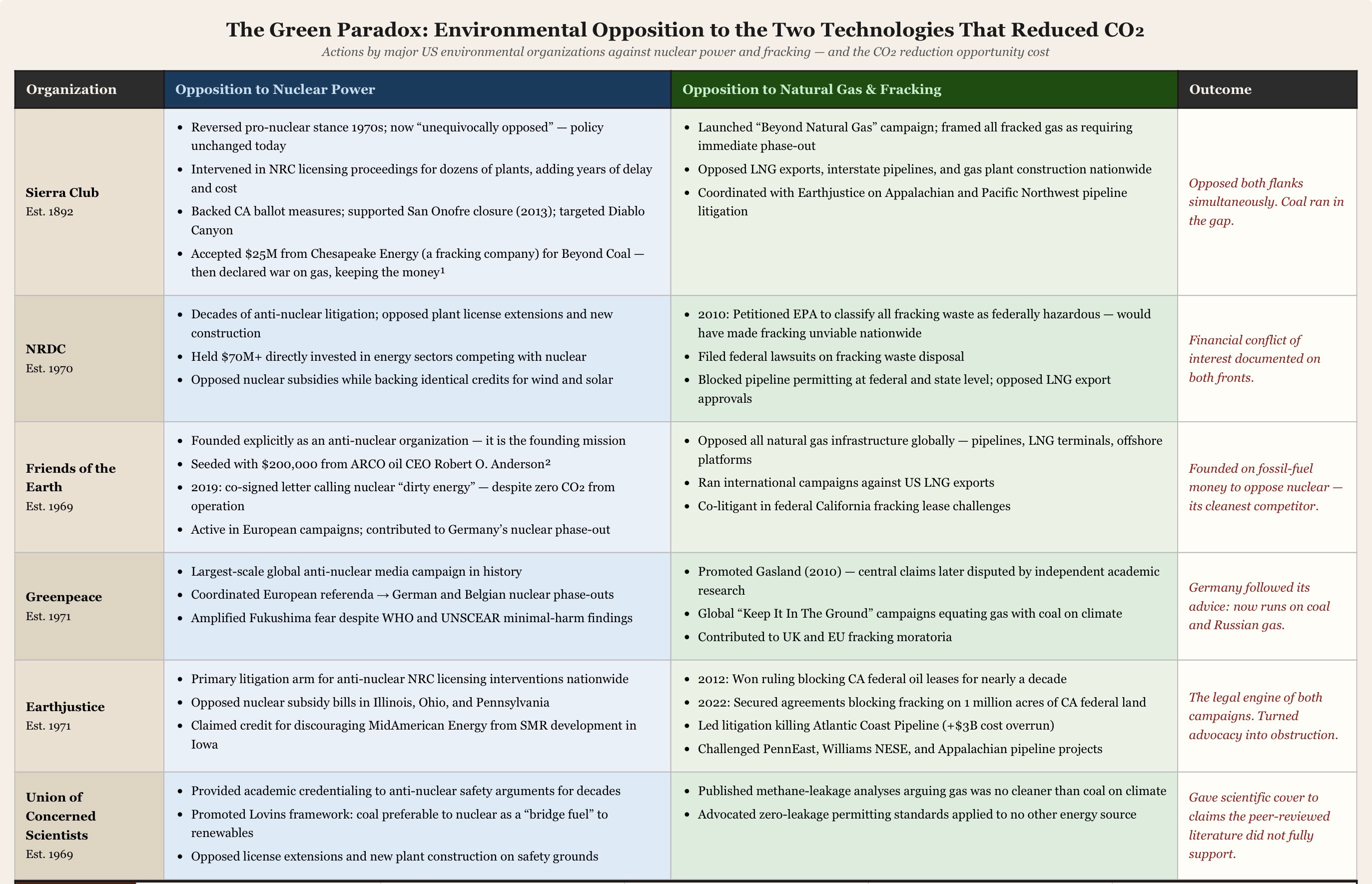
Walsh, B. “How the Sierra Club Took Millions From the Natural Gas Industry.” TIME, February 2, 2012. ² Adams, R. “Smoking Gun: Robert Anderson Provided Initial Funds to Form Friends of the Earth.” Atomic Insights, August 2013.
CO₂ data: U.S. Energy Information Administration (June 2021, September 2025); Center for Climate and Energy Solutions (February 2026); U.S. DOE historical records. Financial conflicts: Environmental Progress, “The War on Nuclear.”
The core tool is not persuasion — it is delay. In energy infrastructure, time is money in a direct and compounding sense. A pipeline under construction is capital deployed and generating no return. A drilling permit tied up in litigation is a project that cannot begin. The National Environmental Policy Act, the Clean Water Act, and the Endangered Species Act each create procedural requirements that, when litigated by well-resourced organizations, can add years and hundreds of millions of dollars to projects that were fully permitted under governing regulations.
The Atlantic Coast Pipeline — a 600-mile project designed to move Appalachian natural gas to Mid-Atlantic markets — was cancelled in 2020 after years of litigation drove its projected cost from $5 billion to $8 billion. The PennEast Pipeline faced a decade of legal challenges. New England’s inability to build adequate gas pipeline capacity left the region dependent on liquefied natural gas shipped from as far as Russia — a direct consequence of the same organizations’ success in blocking domestic infrastructure.
This is precisely the mechanism that destroyed nuclear economics in the West. Mid-construction design changes mandated by NRC rule changes — themselves driven by anti-nuclear litigation — eliminated the industrial continuity that makes complex projects affordable. South Korea and China, building identical technology under stable regulatory conditions, maintained nuclear construction costs at $2–$3 per watt. The United States reached $14–$15 per watt. The technology was unchanged. The regulatory weaponization was the variable.
VI. What Fracking Actually Delivered
Against this backdrop of sustained opposition, the shale revolution proceeded — partially, imperfectly, in the states and on the federal lands where it was not blocked — and delivered results that no other energy technology matched.
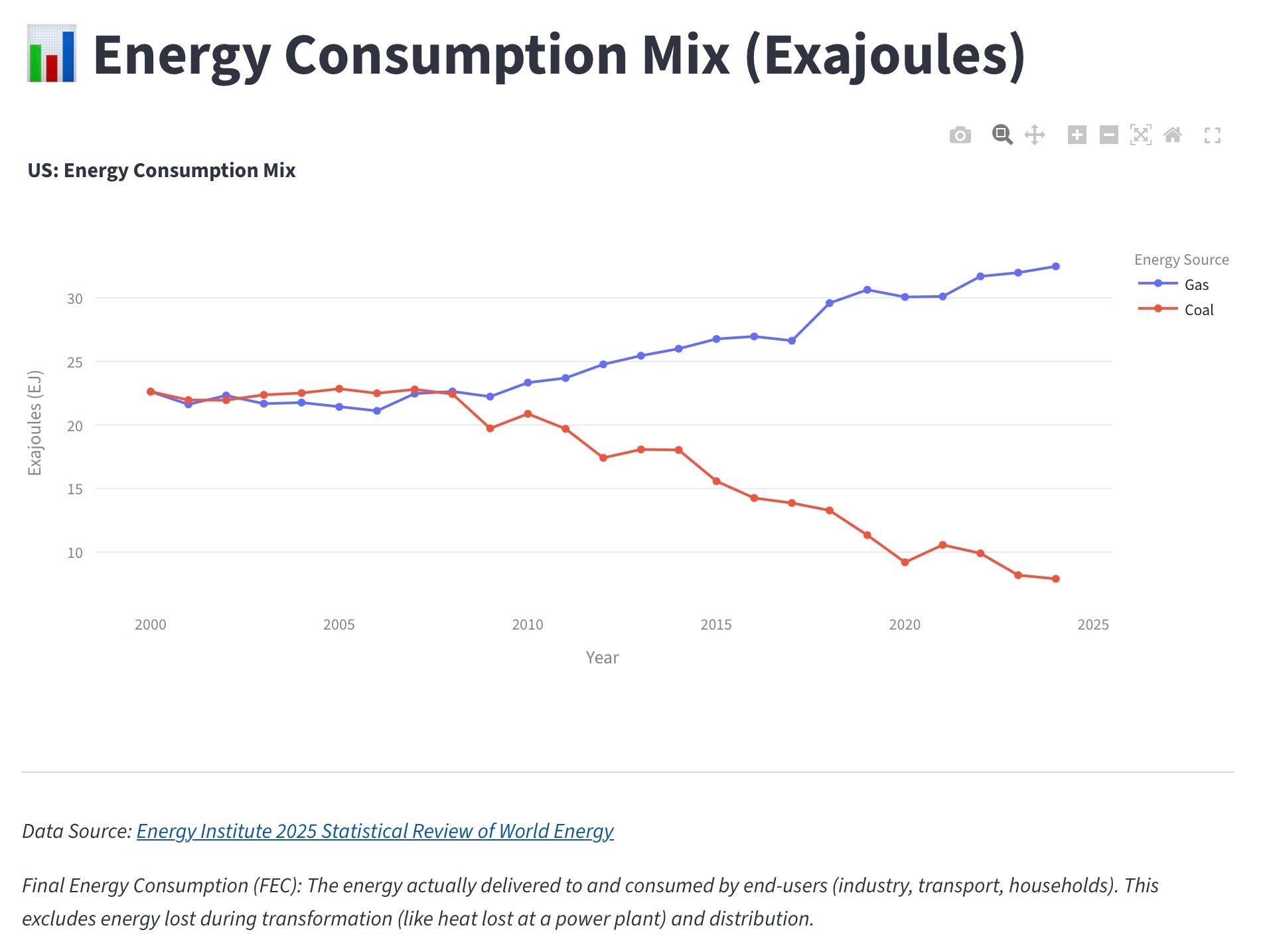
Figure 1: US Energy Consumption Mix 2000–2024 — Natural gas (blue) rises from ~22 EJ to ~32 EJ as coal (orange) collapses from ~23 EJ to ~9 EJ, a divergence of nearly 40 EJ by 2024. Source: Energy Institute 2025 Statistical Review of World Energy.
The chart above captures the physical reality of what the shale revolution produced. Two lines, moving in sharply opposite directions. Coal — which had powered roughly half of American electricity generation for most of the prior century — collapsed from 23 exajoules to under 9. Natural gas, unlocked by fracking from shale formations that had been economically inaccessible for decades, rose from 22 exajoules to 32. The consequences for CO₂ emissions were immediate, large, and sustained.
Natural gas and coal are not merely different fuels — they are fundamentally different in their carbon consequences. When combusted to generate electricity, natural gas produces approximately 50% less CO₂ per unit of energy than coal: roughly 53 kg of CO₂ per million BTU for natural gas versus 95 kg for coal, according to the EIA. At scale, that differential is transformative. Every exajoule of generation shifted from coal to gas cuts associated CO₂ emissions in half. The chart above shows that shift happening in real time across the US economy — coal consumption collapsing from 23 exajoules to under 9, natural gas rising from 22 to 32. The arithmetic is direct: had coal held its 2005 position and gas not expanded, the US power sector would have emitted roughly 500 million additional metric tons of CO₂ annually by the end of the period — equivalent to putting 100 million additional cars on the road every year. Fracking made cheap, abundant natural gas possible. The CO₂ math did the rest.
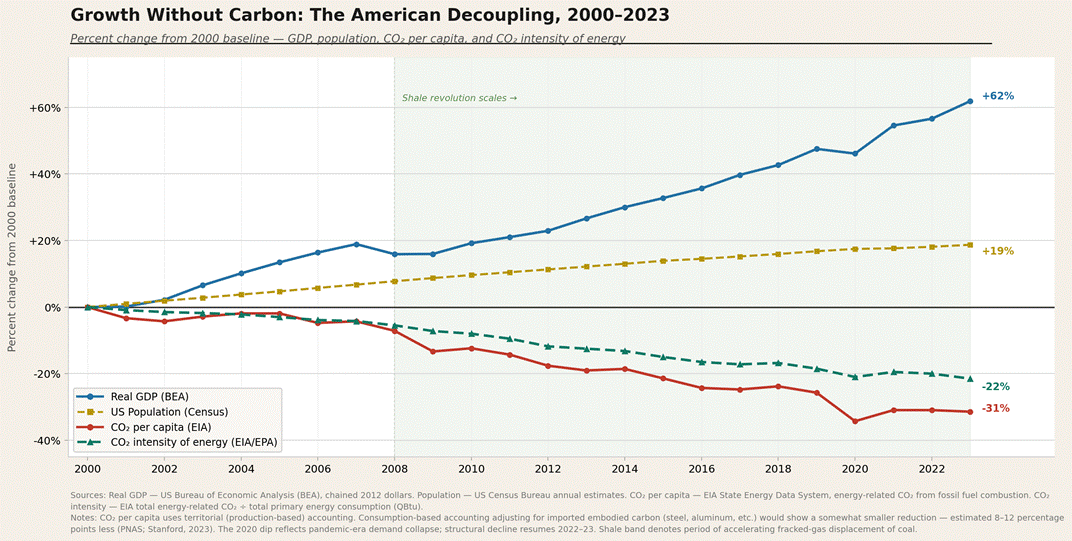
Figure 2: Growth Without Carbon — The American Decoupling, 2000–2023. Real GDP +62%, population +19%, CO₂ per capita −31%, CO₂ intensity of energy −22%. Sources: BEA, US Census, EIA, EPA.
Figure 2 places those physical changes in economic context. Between 2000 and 2023, the United States grew its economy by 62% in real terms and added 53 million people — while cutting CO₂ per person by 31% and reducing the carbon intensity of its energy by 22%. The economy and population moved one direction. The carbon moved the other. That divergence is the definition of decoupling, and it is among the most consequential environmental achievements in American history.
Of the 819 million metric ton decline in US power sector CO₂ from 2005 to 2019, approximately 532 million metric tons — 65% — came from the shift from coal-fired to natural gas-fired electricity generation.
The EIA’s own analysis is unambiguous on the driver. Of the 819 million metric ton decline in US power sector CO₂ from 2005 to 2019, approximately 532 million metric tons — 65% — came from the shift from coal-fired to natural gas-fired electricity generation. Wind and solar contributed approximately 248 million metric tons, or 29% of the total reduction. That contribution is real and should be acknowledged. It is also worth noting what it cost and how it was delivered: wind and solar are intermittent technologies requiring full backup capacity, commanding premium grid infrastructure investment, and receiving sustained federal and state subsidy throughout this period — yet delivered less than half the CO₂ reduction of a technology the same organizations were simultaneously trying to ban. Fracking-enabled gas, by contrast, reduced emissions across the full energy economy — heating, industry, and power generation simultaneously — driven entirely by market economics, without subsidy.
The per capita numbers complete the picture. US energy-related CO₂ per person fell 30% from 2005 to 2023 — in every single US state without exception, per the EIA. Power sector CO₂ emissions fell 41% through 2024. These are not marginal improvements. They represent the largest sustained reduction in American carbon emissions ever recorded, driven overwhelmingly by a technology the country’s most prominent environmental organizations spent years trying to prohibit.
A note of intellectual honesty is warranted. The figures above use territorial accounting — what was emitted on American soil. Consumption-based accounting, adjusting for carbon embedded in imported steel, aluminum, cement, and other energy-intensive goods that moved offshore to coal-powered grids, shows a somewhat smaller reduction: roughly 8–12 percentage points less. The achievement is real. It is somewhat overstated by standard methods.
VII. Why These Organizations Behave This Way
The question the evidence forces is not simply whether the environmental organizations were wrong about fracking’s risks — they were, substantially, on the central claims. The deeper question is why they were wrong in this particular direction, with this particular persistence, against two technologies whose safety and emissions records were documented in peer-reviewed literature available to their own scientists.
The financial record provides one answer. Between 2007 and 2010, the Sierra Club accepted over $25 million from Chesapeake Energy — one of the largest fracking companies in the United States — to fund its Beyond Coal campaign, then reversed course and declared war on the industry that had funded it, keeping the money.¹ Friends of the Earth was seeded with a $200,000 founding donation from Robert O. Anderson, the chairman and CEO of Atlantic Richfield (ARCO), an oil company — an organization created to oppose nuclear power, bankrolled by a fossil fuel executive.² Environmental Progress documented that the Sierra Club has taken at least $136 million from natural gas and renewable energy interests that stood to profit directly from nuclear plant closures. The NRDC held a minimum of $70 million invested in energy sectors that competed with nuclear.
The institutional logic provides the rest. Organizations built around opposition to specific technologies develop fundraising bases, donor relationships, political coalitions, and professional staff whose livelihoods depend on the continuation of that opposition. Reversal is institutionally costly in ways that ideological persistence — however empirically wrong — is not. When fracking arrived and began displacing coal more effectively than any renewable technology had managed, the same institutional immune system that had rejected the nuclear evidence rejected the fracking evidence. The target changed. The machinery did not.
VIII. The Verdict
Here is what the record shows.
Fracking was the most effective CO₂ reduction technology deployed in the United States in the modern era — by a wide margin. It displaced coal from the electricity grid faster than any policy instrument had managed, cut power sector emissions by 41%, drove per capita CO₂ down 30% across every state in the country, and delivered 65% of all power sector emission reductions during the peak displacement period. The claims made against it — widespread groundwater contamination, catastrophic methane leakage, seismic destruction — were amplified with the same confidence and the same institutional machinery that had turned Three Mile Island’s contained accident into a generation of public terror. In both cases, the evidence was available. In both cases, it was not followed. In both cases, coal filled the gap. Complicit.
The organizations that ran these campaigns are still operating, still fundraising, and still describing themselves as defenders of the planet. They opposed the technology that delivered the largest CO₂ reduction in American history and most still do to this day. They opposed the nuclear technology that could have decarbonized the US grid by the 1990s and most still do to this day. They called both of them dangerous. The data says otherwise.
The financial conflicts are documented. The institutional incentives are clear. The outcomes are measured. And the pattern — two technologies, fifty years, the same organizations, the same tactics, coal burning in the gap both times — is not a series of honest mistakes in the face of genuine uncertainty.
There is a word for a pattern this consistent, this well-documented, and this consequential. It is not environmentalism. It is its opposite.
References
5. Center for Climate and Energy Solutions. “U.S. Emissions.” C2ES, February 2026.
11. Liu, S. et al. “Can China break the cost curse of nuclear power?” Nature, 2025.
13. Energy Institute. Statistical Review of World Energy, 2025.
14. U.S. Bureau of Economic Analysis. Real GDP, chained 2012 dollars, 2000–2023. Federal Reserve FRED.
https://substack.com/@tinamariejordan/note/c-267940351?r=8il34p&utm_medium=ios&utm_source=notes-share-action
Thank you. I’ve been looking for an assessment of fracking from a non-industry source, and this does a good job of outlining the issues. The parallel with NGOs’ demonization of nuclear is particularly useful. Yes, there are legitimate reasons to proceed with some caution, but these NGOS—with the willing cooperation of the media—have distorted a nuanced reality to conform to certain narratives. The risks must be weighed carefully against potential benefits.
I’ve watched cities in NYS virtuously ban fracking when they’re even not located in regions where fracking would typically take place. It sounds like “good environmentalism” to them but has little to do with science. I still don’t feel like I have a clear enough picture to say the state ban is 100% unwarranted, but I do think it needs to be reassessed.