Four Systems Problem - tl;dr
The true cost of displacing nuclear with wind and solar - a short summary

Yesterday I posted a detailed analysis of the cost of firming a 1 GW solar or wind system to take the place of a 1 GW nuclear plant with a 60 year life and 93.5% uptime (standard). I undertook this analysis because in the West over the last 25 years our principle clean energy actions have been adding new solar and wind (and some storage) while net decommissioning nuclear capacity. These actions, versus words like ‘we have an all of the above strategy’ define our lived decarbonization strategy - more solar and wind and less nuclear. So the question is, how cost effective are solar and wind when taking the place of reliable, dispatchable nuclear generation?
The West has decommissioned 50 gigawatts of nuclear since 2000 while adding 930 gigawatts of wind and solar nameplate — by default, wind and solar are our sole decarbonization policy
What follows below is a brief summary of the more extensive analysis posted earlier. Far more detailed information about costs, assumptions and references can be found there.
The Four Systems Solar and Wind Model
Solar and wind both require four systems to replicate the one system of a nuclear plant. They require,
System 1 - Base generation: 3.7 GW of solar panels (or 2.65 GW of wind turbines) to average 930 MW of continuous output at a 25% (or 35%) capacity factor
System 2 - Charging overbuild: an additional 2.0 GW (solar) or 2.2 GW (wind) dedicated solely to charging the battery during peak generation hours
System 3 - Storage: 16 or 24 hours for intra-day energy shifting (there is no viable multi-day storage technology available)
System 4 - Natural gas peaker: for multi-day low sun, or multi-day low wind conditions
By contrast a nuclear plant is one integrated system requiring a single GW operating at 93.5% availability to offer 930 MW of realized capacity.
How Much of Each?
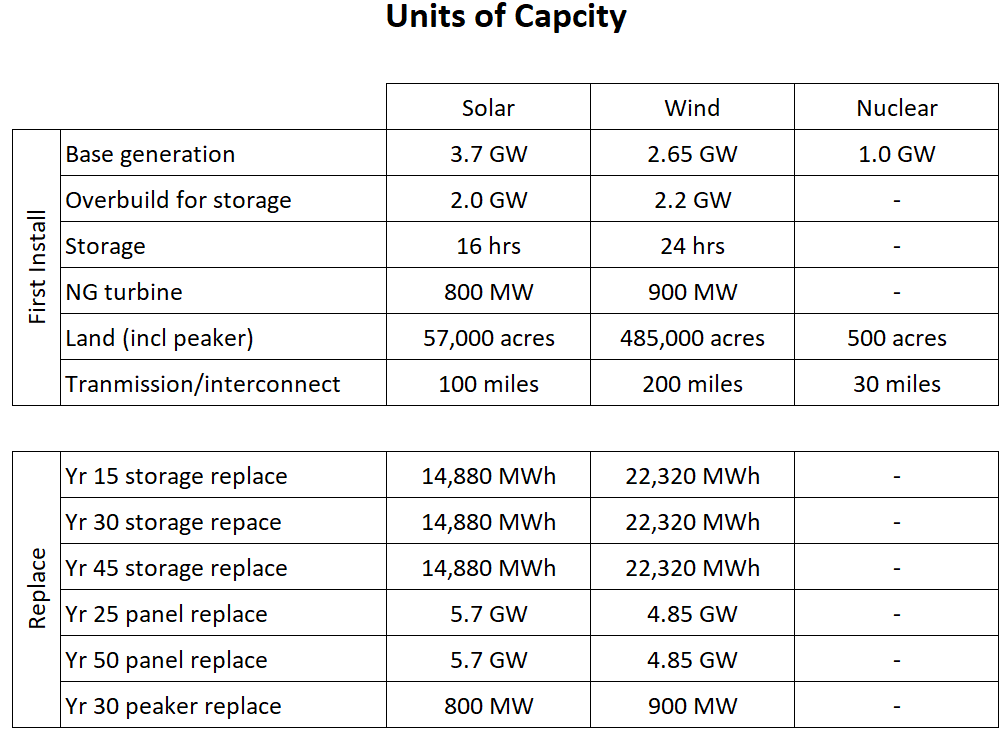
The table below describes the equipment and infrastructure required for the three options laying out first installs as well as necessary replacements for solar panels (25 year life), grid batteries (15 year life) and the NG peaker plant (30 year life). In contrast a nuclear plant requires only one system and has no required replacements over its 60 year useful life.
At What Cost?
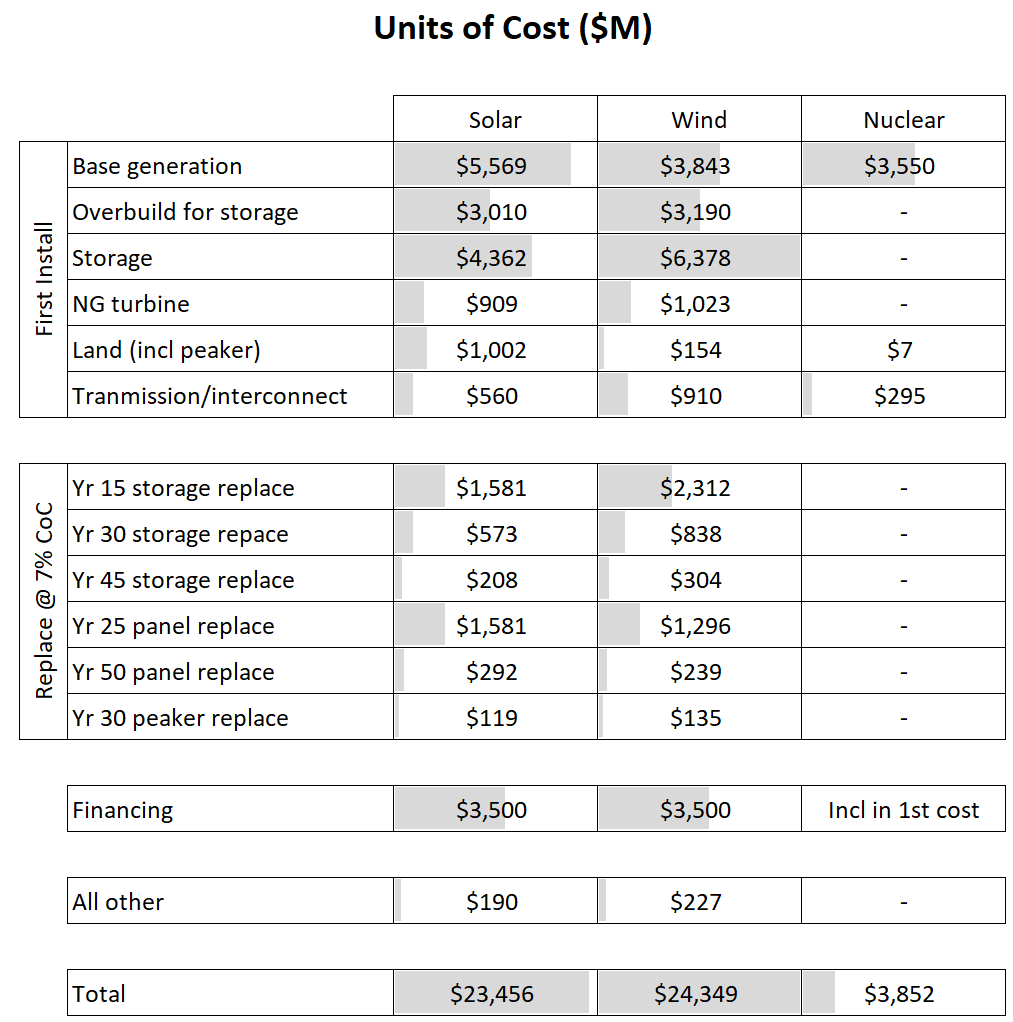
The nominal costs of these options are $23.5B for solar, $24.3B for wind and $3.9B for nuclear. The table below provides extended costs for each of the units of capacity or infrastructure. All cost numbers are nominal and well referenced industry standards. Future costs are discounted back to today’s dollars at a 7% cost of capital. Detailed ranges for unit costs as well as assumptions and sources can be found in the original detailed article. The cost of a nuclear plant is based on actual GW-scale plants built by China and South Korea over the past five years. This represents the cost when a country employs a fixed design, dedicated teams and rational regulations - and does so over-and-over. The cost used here is this well-established ‘one-of-many’ model versus the ‘one-of-one’ designs, ad hoc teams and overly-restrictive regulations of the West - looking at you Vogtle.
What it all Means
Using solar or wind to substitute the same output, reliability and life-cycle performance of a nuclear plant requires four systems and meaningful replacements. The nominal costs of these options are $23.5B for solar, $24.3B for wind and $3.9B for nuclear. In addition, solar and wind take orders of magnitude more land, longer transmission from remote locations and produce more GHG’s (requiring NG peakers).
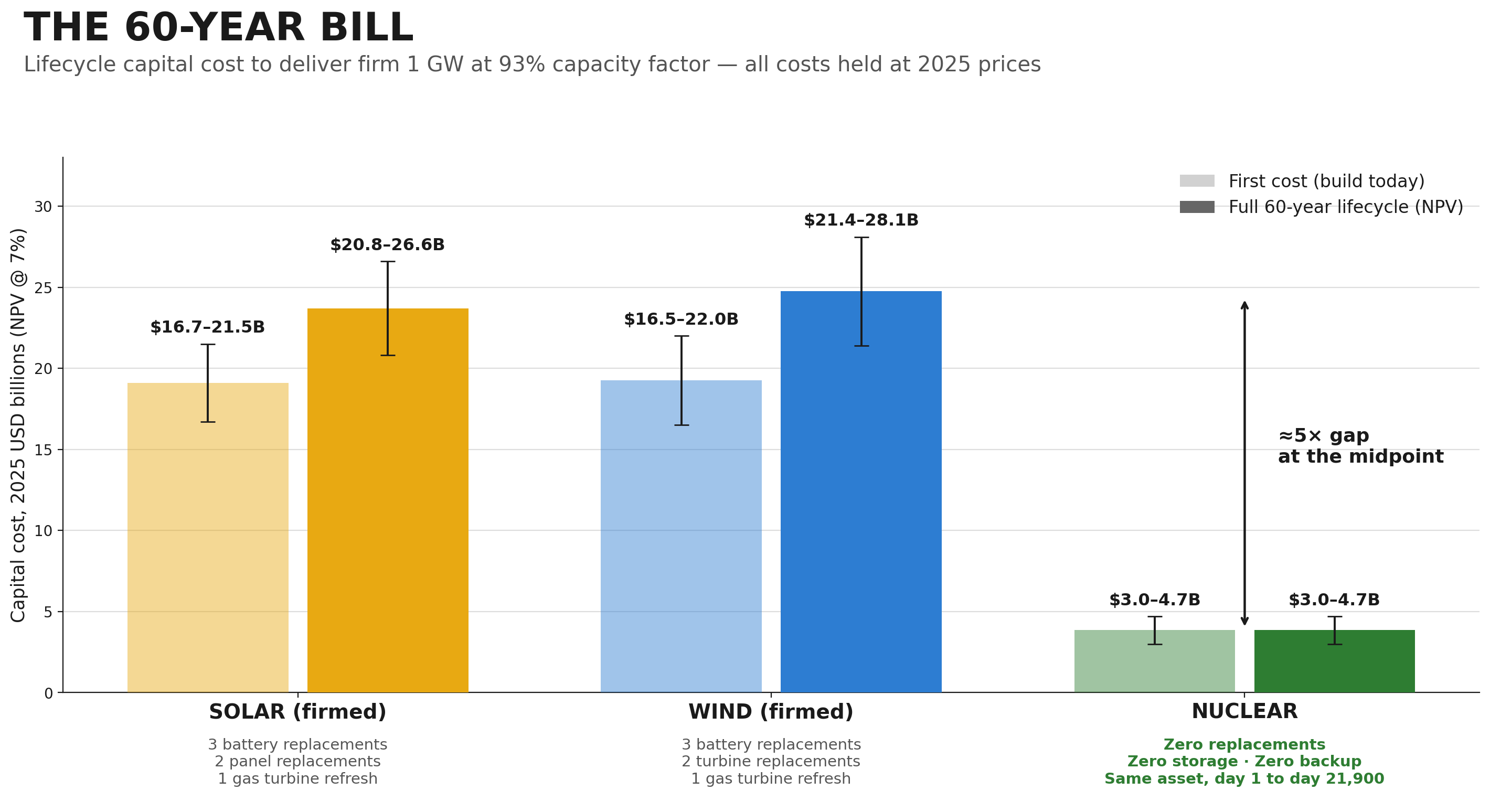
Firmed solar or wind costs six times more than nuclear. Both still need a gas plant.
All of the details of this analysis including unit cost ranges, critical assumptions and full references can be found in my original article (here).
Editorial - Why does this Matter: Anatomy of a Failure
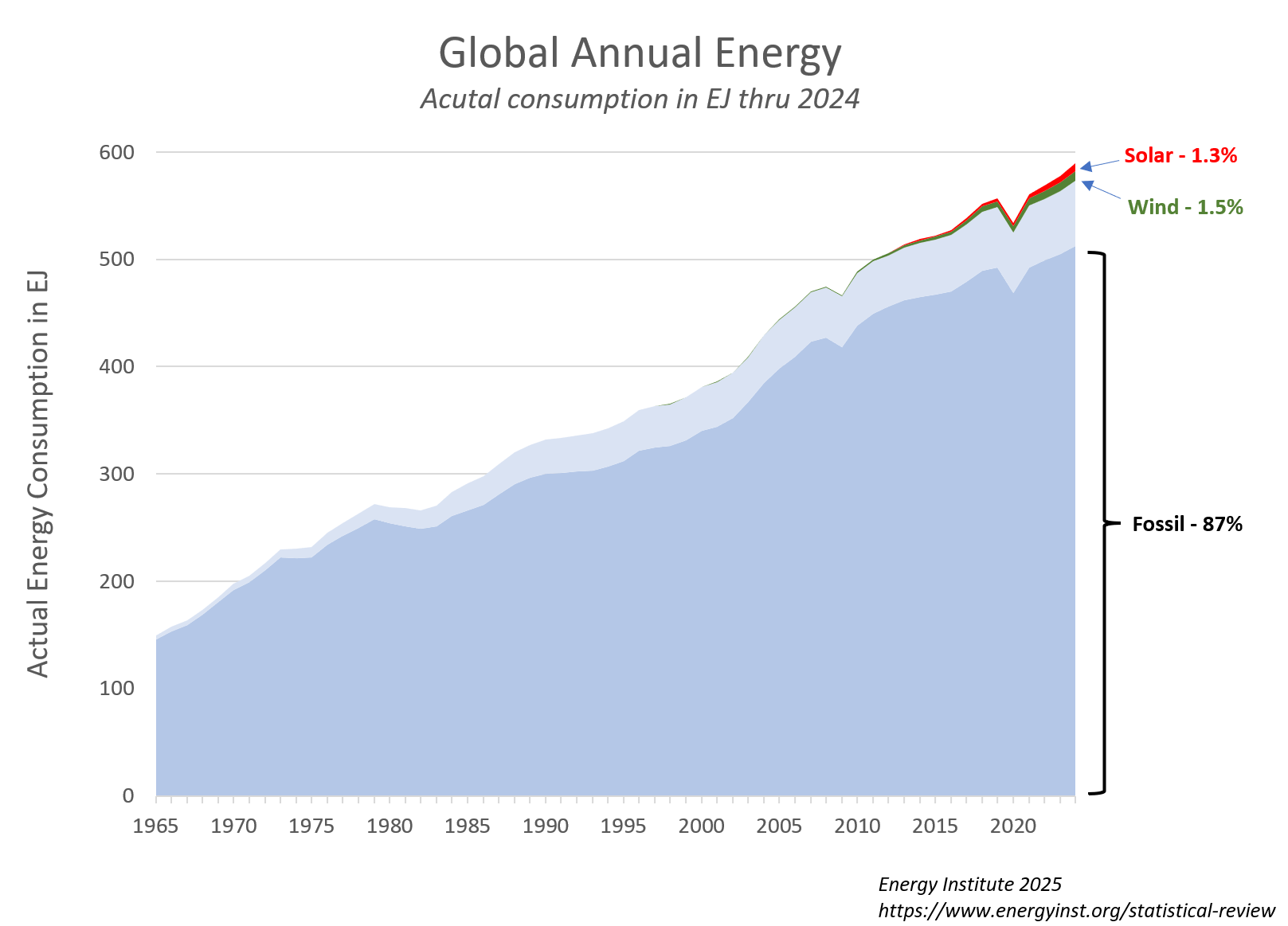
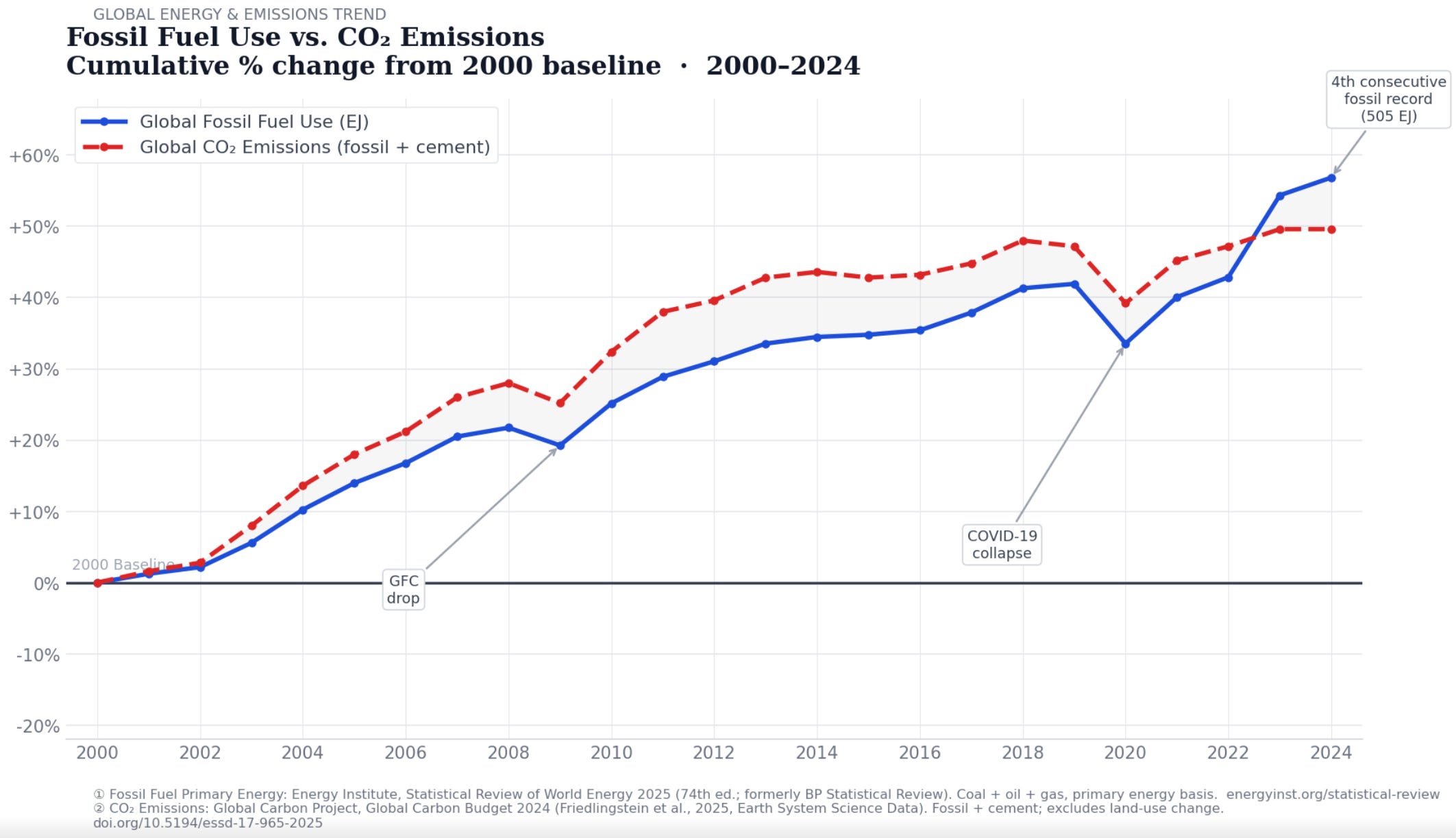
I believe our solar and wind approach of the past 25 years has been an unqualified failure for reasons I describe here. The most damning proof of our failed green energy transition can be found in the two graphs below. After 25 years and $11 trillion invested in solar and wind, they make up collectively less than 3% of global energy (2024). Over the same time both fossil use and CO2 emissions are up 50-60%. These are not the outcomes of a successful transition and we are not being serious about it.
For the $11 trillion the world has invested in solar and wind over the past 25 years, the same money spent on nuclear would have built enough firm zero-carbon capacity to power 80% of global electricity consumption for the next 60 years. Instead, we built enough solar and wind to power roughly 16% with a fraction of the lifespan.
Thank you Scott for this summary of your recent in-depth criticism of the **failure** of massive investments in solar and wind generation coupled with battery storage instead of investing in expansion of nuclear power. My perspective is the eleven trillion dollars spent to date by the West on these inherently unreliable electricity sources instead of nuclear power is wasted capital.
I’ll be referring to this regularly in my own writing.